
Companies across Belgium are actively experimenting with artificial intelligence. Many organizations now have an AI strategy. There are pilots. Employees are experimenting with generative AI. Dashboards are being built, forecasts improved, and processes automated. Increasingly, companies are developing AI agents. But the real challenge begins when AI becomes embedded in processes, decision-making, and the operating model.
The reality, however, tells a less straightforward story. A recent TriFinance survey of executives and senior management shows that while AI is present in many organizations, the transition from experimentation to systematic adoption is far from complete.
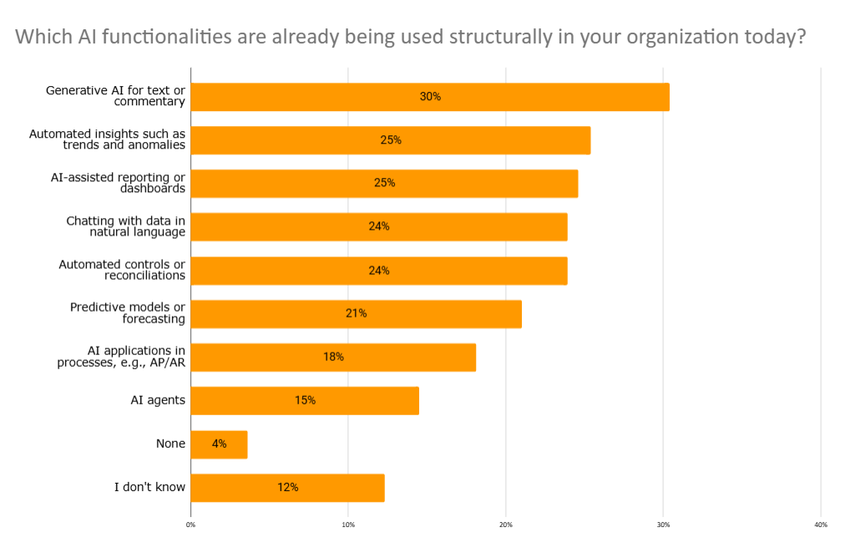
At 30%, Generative AI for text and commentary is the most commonly reported form of AI in regular use. Automated insights such as trends and anomalies follow at 25%, as do AI-enabled reporting and dashboards. One notable finding is that 15% of respondents say AI agents are already being used systematically.
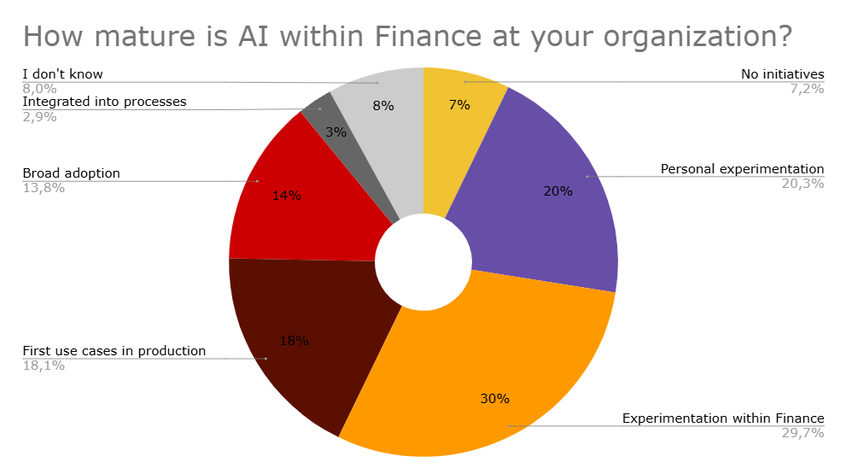
That may look like rapid progress. But there is another side to the numbers: only 3% of respondents say AI is already fully integrated into Finance processes. Another 14% report broad AI adoption, while 18% say their first use cases are already in production. The largest group (30%) is still in the experimentation phase within Finance. Another 20% are experimenting with AI on an individual basis.
The survey confirms a paradox we frequently see among our clients. AI is accessible to virtually every business function, yet initiatives are still too often driven by IT. The organizations that achieve the greatest success are those where business and IT jointly own the AI agenda.
From experimentation to the operating model
When AI is applied to forecasting, reconciliations, fraud detection, reporting, or finance administration, technology directly affects how an organization operates. Data must be reliable. Processes need to be standardized, and responsibilities clearly defined. People need to be able to interpret and validate AI-generated outputs.
That also means someone needs to own AI.
The survey results show that AI ownership is still evolving across Belgian organizations. IT is identified as the leader of AI initiatives in 39% of organizations. A transformation team follows at 22%. In 9% of organizations, an AI officer leads the initiatives, a share equal to those where the business leads or where no formal leadership role has been defined. C-level leadership accounts for just 6%, while 7% of respondents do not know who leads the initiatives.
‘The survey confirms a paradox we frequently see among our clients,’ says Johan Reunis, Expert Practice Leader Business Integration at TriFinance. ‘AI is accessible to virtually every business function, yet initiatives are still too often driven by IT. The organizations that achieve the greatest success are those where business and IT jointly own the AI agenda.’
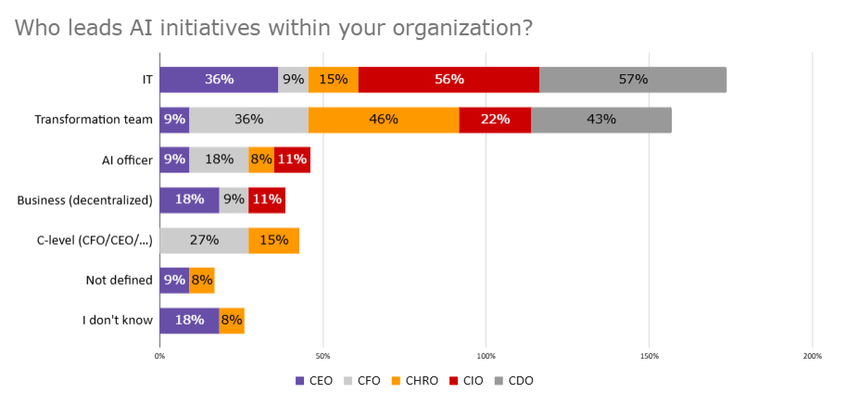
The picture becomes more interesting when the C-suite is broken down by individual roles. Each role brings a different perspective. The answer, in other words, depends on whom you ask.
For CIOs, the answer is hardly surprising: 56% of CIO respondents identify IT as the driving force behind AI initiatives. Among CDOs, that figure is even higher, at 57%. At the same time, transformation teams play an important role for CDOs as well, cited by 43%.
Among CEOs, the picture is more distributed: 36% identify IT as the leader of AI initiatives, while 18% see the business as the driving force and 9% point to a transformation team or AI officer. For CFOs, the center of gravity shifts again. Thirty-six percent identify the transformation team as the leader, while 27% cite C-level leadership. IT ranks much lower among CFOs, at 9%. Another 18% identify an AI officer.
These differences matter. They do not necessarily mean that organizations are contradicting one another. They do suggest, however, that AI ownership is experienced differently from different management perspectives. For technology leaders, AI is primarily an IT and data challenge. For CFOs, transformation and executive sponsorship appear to carry greater weight. CEOs, meanwhile, more often see a role for the business.
AI governance cannot simply be captured in an organizational chart. The more important questions are: Who manages the technology? Who champions the business case? And who takes responsibility when AI actually begins to change the organization?
The ambition to create impact with AI is growing faster than organizations’ capacity to realize that ambition. Yet alongside the urgency to create impact, there is a striking gap in AI maturity and in the development of the capabilities needed to deliver it.
Finance and the AI Value Paradox
When AI is viewed primarily as an IT initiative, the emphasis naturally falls on technology, infrastructure, and implementation. But the greatest value from AI emerges elsewhere: in processes, decisions, and the way people organize their work.
When the expected value of AI grows faster than its ownership, and an organization’s competencies and capabilities to realize that value, what you might call the AI value paradox emerges.
The Finance function provides a particularly clear example of that AI value paradox. It has access to large volumes of structured data and relies on highly repetitive processes, making it especially well suited to AI applications. Forecasting, variance analysis, reconciliations, management reporting, and anomaly detection can all benefit from automation and intelligent support.
The survey confirms this potential. When respondents are asked where they expect AI to have the greatest impact, they rank “Automating operational processes through AI agents” first, at 33%, followed by forecasting at 27%, and anomaly and fraud detection, management commentary, and data-quality monitoring at 25% each.
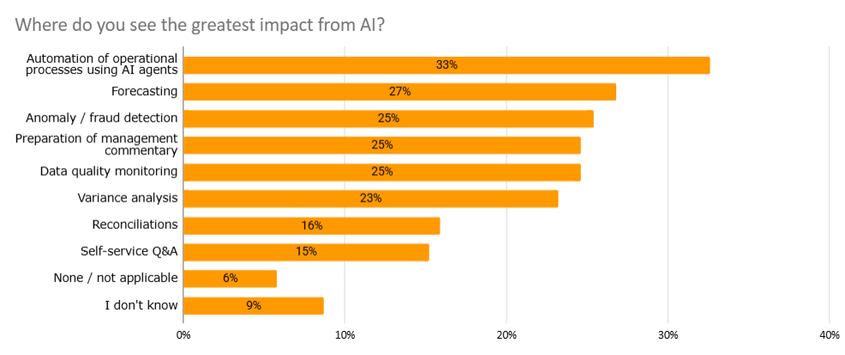
The urgency is not merely theoretical. Among respondents who rate the optimization of financial systems and processes as highly urgent or critical, 47% say AI agents for operational automation will have the greatest impact. For forecasting, the figure is 31%, while 33% point to anomaly and fraud detection.
“The ambition to create impact with AI is growing faster than organizations’ capacity to realize that ambition,” says Stéphanie Struelens, Expert Practice Leader Transformation Solutions at TriFinance. “Yet alongside the urgency to create impact, there is a striking gap in AI maturity and in the development of the capabilities needed to deliver it.”
Only 8% of respondents rate AI capabilities within the Finance team as present “to a very great extent,” while 25% say they are present “to a great extent.” By contrast, 38% say these capabilities are present only to a limited extent, and 17% to a very limited extent.
For organizations, this is likely to become one of the defining management challenges of the next phase of AI adoption.


