
An approved annual budget gives executive leadership a reassuring sense of control. Yet in an economy shaped by volatile commodity prices, fragile global supply chains, rapid shifts in customer behavior, and macroeconomic uncertainty, a static plan quickly loses its strategic steering value.
Despite this reality, many organizations continue to navigate strictly by an annual budget or, at best, backward-looking quarterly forecasts. The underlying cause is rarely a lack of strategic ambition. Rather, until recently, collecting fragmented data, reconciling disparate operational systems, and calculating multi-variable scenarios consumed far too much time and manual capacity.
At its core, continuous planning is not about perpetual, exhausting rebudgeting. It is about decision readiness: being continuously prepared to make the right strategic calls whenever market conditions change.
With AI in financial planning and analysis automating routine data ingestion and calculation cycles, the historical technical bottleneck has dissolved. The conversation now shifts from data mechanics to operational execution: how do you structure your processes, data architecture, and leadership culture to transform algorithmic outputs into faster, superior business decisions?
From calendar-driven to event-driven steering
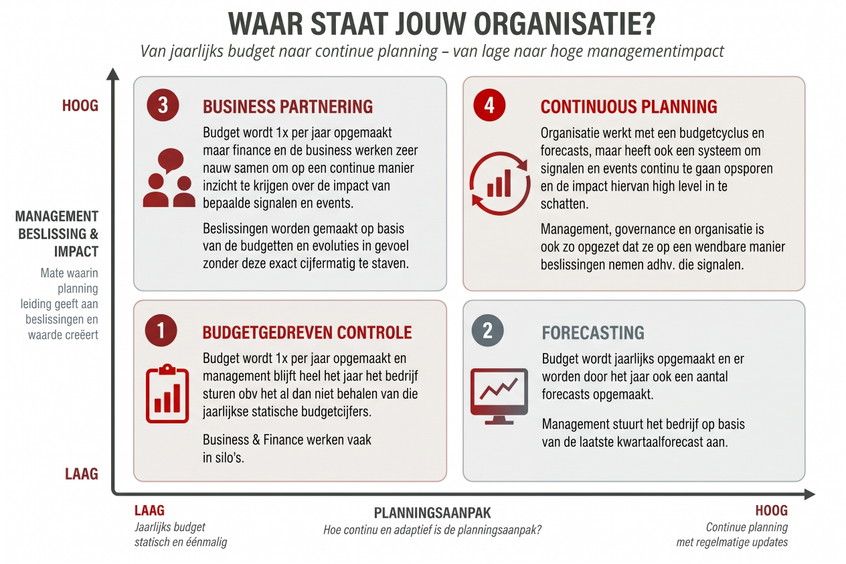
Embracing continuous planning requires finance leaders to step away from the comforting rigidity of the traditional financial calendar. While traditional annual budgets and quarterly forecasts serve as static anchors in time, continuous planning is fundamentally event-driven. The planning rhythm is no longer triggered by an arbitrary date on the calendar, but by material events across external markets or internal operations.
Whether confronting unexpected supplier price hikes, abrupt foreign exchange volatility, changes in consumer demand, or channel disruptions, the strategic objective is proactive signal detection. Organizations must capture early indicators and calculate their direct impact across the P&L, balance sheet, and liquidity profile. This agility enables executive management to course-correct precisely when it matters, rather than waiting weeks for the next scheduled forecasting iteration.
However, finance leaders must recognize that continuous planning represents the pinnacle of finance maturity. It is not an entry-level exercise, and foundational steps cannot be skipped. Before transitioning to an event-driven steering model, you need to get your basics right: dependable, standardized data flows, a streamlined month-end close, and an established, disciplined process for rolling forecasts.
Continuous planning is not about constant rebudgeting; it is about continuous decision readiness.
The three pillars of successful continuous planning
Generating a forecast faster does not inherently produce a superior decision-making engine. To turn continuous planning into a sustainable operational asset, organizations must orchestrate three interdependent pillars: processes, leadership culture, and technology.
1. Processes and governance: proper structure determines response time
Transitioning from calendar-bound schedules to event-driven triggers removes the familiar cadence of the traditional planning cycle. To prevent organizational fatigue or ad-hoc chaos, finance must replace the static calendar with clear governance and transparent rules of engagement. Both the decision to initiate a new scenario simulation and the resulting business review require clear governance.
Organizations must define upfront which operational drivers are truly material and what threshold of variance justifies recalculating financial projections. Who is responsible for tracking these variables? At what tolerance limits should an operational deviation be escalated to executive leadership?
A disciplined variance analysis plays a crucial role here, pinpointing statistically significant anomalies in operational performance and isolating root causes before they compound.
2. People, organization, and leadership: the underlying cultural shift
The transition to continuous planning rarely stalls because of financial algorithms or spreadsheet limitations. More often, it stumbles over entrenched corporate habits, organizational silos, and hierarchical reflexes. Building an agile planning cadence requires a fundamental cultural transformation across the finance function and the executive board, focusing on three specific shifts:
- Shared driver ownership: Planning cannot remain an isolated finance exercise. The real drivers of commercial revenue, talent capacity, operational throughput, and supply chain resilience reside within the business units. Finance establishes the analytical framework, provides governance, and challenges underlying hypotheses, but decentralized business owners must hold direct accountability for operational drivers and commercial assumptions.
- Unlearning perfectionism: Finance professionals are classically trained to pursue absolute precision down to the last cent. In continuous planning and predictive analytics in finance, excessive precision is counterproductive. Waiting for complete data certainty paralyzes decision-making. Strategic agility requires steering by orders of magnitude, probabilistic outcomes, and statistical ranges. In fast-moving markets, directional accuracy and "good enough" data trump delayed perfection every time.
- Adaptive performance management: You can demand agility, but behavior follows incentives. Tying executive compensation, departmental bonuses, and performance appraisals strictly to fixed, static budget targets set twelve months prior directly sabotages an agile culture. To succeed with continuous budgeting and dynamic forecasting, leadership evaluations must decouple from outdated static targets. Leaders should be rewarded for proactive strategic adjustments that safeguard enterprise value when market conditions change.
More about finance transformation
Transformation Solutions3. Data, systems, and AI: EPM as the foundation, AI as the accelerator
Linking operational metrics (such as unit volumes, supply lead times, customer turnover, or commodity indices) to granular P&L, balance sheet, and liquidity outcomes demands a resilient technological infrastructure. Enterprise Performance Management (EPM) systems serve as the foundational backbone: they unify fragmented data silos, automate routine ingestion pipelines, and provide the governance necessary for robust scenario modeling.
Equally vital is the semantic data layer. No matter how advanced an algorithm might be, AI for financial planning cannot deliver reliable insights without unambiguous business definitions and structured contextual metadata. What precisely constitutes recurring revenue or gross margin across different business units? What operational logic governs cost allocation? Only when this semantic layer is clearly standardized can AI operate safely, reliably, and effectively as an analytical engine.
Once that foundation is in place, AI in FP&A delivers value across three levels within dynamic planning processes:
- Detection: Algorithms detect anomalous patterns and identify shifts in underlying drivers far faster than the human eye.
- Analysis and simulation: By unlocking structured data sources, AI scenario planning models alternative future outcomes and sensitivities in a fraction of the time. We see this same principle in AI cash flow forecasting, where machine learning forecasting handles sudden market volatility with significantly higher accuracy.
- Decision preparation: The model structures complex decision pathways and synthesizes key trade-offs, enabling the board to focus immediately on strategic debate rather than data collection.
A faster forecast does not automatically produce better decisions. The true shift is an organizational and cultural transformation.
The evolving role of the controller: from detail modeling to business value
When the application of AI in finance automates intensive data preparation and calculations, it creates space for a far more strategic controlling function. Here, AI serves as an advanced research tool and challenger, but explicitly not as the decision-maker. Especially during disruptive, unprecedented market events where algorithms lack sufficient historical data to produce reliable forecasts, human judgment remains indispensable.
Tomorrow's finance professional combines these advanced digital tools with sharp business acumen. The core value lies in critically validating model outputs, asking business owners the right questions, making underlying assumptions transparent, and optimally equipping executive leadership to make strategic choices.
The first steps toward an agile planning cycle
Continuous planning is a complex leadership challenge, yet its implementation demands a pragmatic start. Begin with the fundamentals: ensure data readiness, clear definitions, and a solid, fast month-end close.
Technology and AI models are more powerful and accessible today than ever, but they only deliver value when you know exactly which signals dictate your company's course. That is why you should start small and highly focused. Ask yourself: what strategic decision is on the near-term agenda, and which three material drivers do we genuinely need to substantiate that choice?
By combining that clear business focus with the accelerating computational power of AI, you finally translate theory into highly effective, continuously agile planning.
Continuous budgeting: moving beyond the limits of static planning
Looking to accelerate your organization's planning cycle, and curious how to effectively integrate data-driven scenarios and AI into your decision-making process? Our finance and data experts are ready to provide a pragmatic assessment of your current maturity and advise you on the right next steps.


