
In most finance functions, the AI conversation opens with a technology check. The data is not clean enough, the systems do not talk to each other, the technology is not embedded deeply enough. All of that is usually true, and none of it explains why one team scales AI into daily operations while another remains stuck in perpetual pilot mode.
Understanding how to build true AI capabilities requires a structured AI maturity model to map your current state to your future state. You need an AI readiness framework that plots exactly where your team stands today, highlights operational bottlenecks, and gives leadership a realistic path to scale AI where it actually delivers measurable results.
Curious where your organization lands right now? By taking our AI readiness scan, you get a clear picture of your exact position within this maturity model in just five minutes.
Take the AI readiness scan
Why technology alone is no longer a competitive advantage
Technology, clean data, and seamless integrations genuinely matter, which is why we spend a good deal of time addressing them alongside our clients. But technology is also the part of the picture that becomes less distinctive over time. As AI models grow more capable and widely available, outputs like cash application automation, AI assisted variance analysis, and predictive AI cash flow forecasting will become capabilities almost every finance team can reach. When everyone gains access to the same technologies, simply owning the software no longer sets your organization apart.
The real differentiator is not technology in isolation, but the combination of powerful tools and human expertise. What remains genuinely scarce is the human side of the equation:
- Domain expertise: Recognizing when a model is hallucinating, relying on flawed assumptions, or missing crucial context. It is about knowing how to set the right parameters, accurately validating the output, and deciding what actions to take when the model gets it wrong.
- Business acumen: Translating statistical outputs into strategic decisions fully grounded in the specific organizational context.
- Tacit knowledge: Leveraging the unwritten institutional experience that lives inside your team.
This is why we regularly see finance functions stall in pursuit of perfectly clean and structured enterprise data, while others move pragmatically by building 'reliable-enough' foundations for targeted use cases. True AI readiness is not achieved by clean data alone, nor can even the most skilled team rescue flawed inputs. It happens when fit-for-purpose data works in tandem with a workforce structured, trained, and supported to execute the high-value judgment calls algorithms cannot replicate.
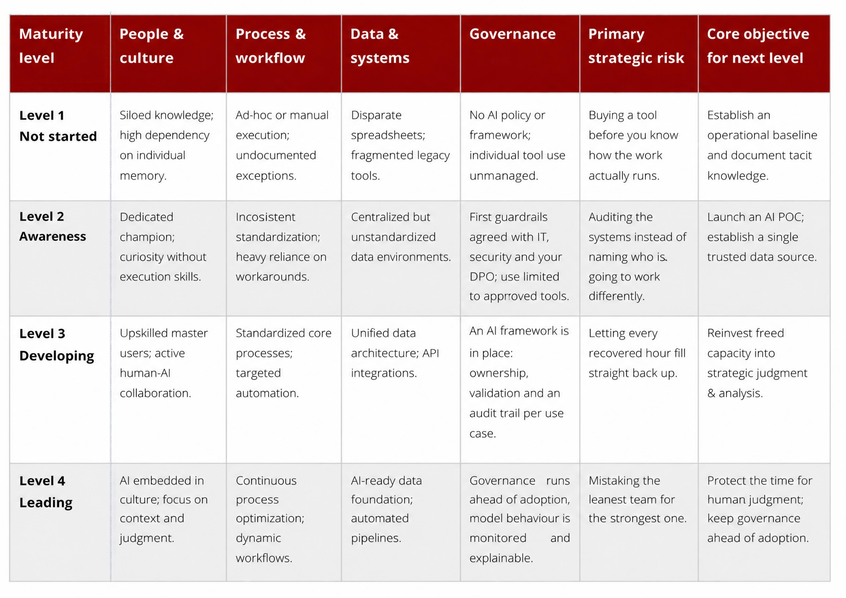
This core principle underpins our comprehensive AI maturity framework, evaluating maturity across the core pillars of every finance organization: people, processes, systems, data, and governance.
The real differentiator is not technology in isolation, but the combination of powerful tools and human expertise. What remains genuinely scarce is the human side of the equation.
The AI maturity model at a glance
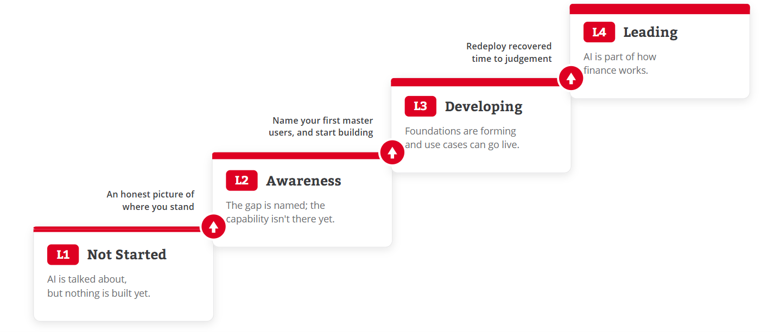
To understand where your finance function currently stands, it helps to see the full picture first. This framework breaks AI maturity down into four clear stages, showing how technology, processes, and human judgment evolve together. Curious which level reflects your finance team’s current reality? Take the AI readiness scan to pinpoint where you stand today.
Level 1: Not started | Mapping baseline knowledge and processes
In brief: AI is discussed at a conceptual level, but no operational capabilities, formal budgets, or dedicated roles exist.
Where your finance team stands
At Level 1, your organization operates primarily through traditional methods. Core workflows such as month-end closes, invoice processing, and balance sheet reconciliations rely heavily on human effort, institutional memory, and local spreadsheets. While executive leadership may express interest in AI adoption, there is no formal owner, dedicated budget, or established AI strategy framework.
What this maturity level means
Despite the aggressive noise surrounding AI in corporate finance, Level 1 reflects the actual operational reality for the vast majority of organizations today. The risk at this stage lies in confusing strategic intent with genuine progress. Organizations frequently fall into the trap of defining what AI should accomplish before understanding how their processes actually run and what the current capabilities of AI are. When asked what success looks like, Level 1 leadership often defaults to immediate cost reduction: achieving the same output with fewer full-time equivalents (FTEs). This narrow focus undermines the broader strategic potential of AI in finance.
Primary threats holding teams back
- Misjudging the technology: Overestimating what AI can do today leads to a pilot that stalls, while underestimating it leaves you waiting for something that already works.
- Tool-first purchasing: Acquiring software before completing basic workflow mapping and data cleansing. Automating an unstable or undocumented process simply accelerates inefficiency at a higher financial cost, pushing teams in a finance process automation trap.
- Losing undocumented expertise: Organizations risk erasing critical knowledge when they view experienced controllers and accounting staff purely as transactional cost centers. Critical operational context, such as understanding why specific journal entries require manual adjustments or how non-standard customer contracts impact revenue recognition, lives in the minds of senior experts. Attempting to replace this human oversight prematurely destroys vital organizational memory.
Advancing in the AI maturity model: how to reach Level 2
To build a foundation for digital finance transformation, you must establish a clear, documented operational baseline:
- Define the value you expect AI to deliver: A good starting point is asking your team what the worst part of the month is. Usually it is the same handful of things: work that gets corrected after the close instead of before it, a question from the business that takes three days to answer, a week that falls apart when one person is on holiday. That is your starting point, and you will want it written down to compare later.
- Conduct a more in-depth AI readiness assessment to evaluate process complexity and data readiness.
- Select a single, high-volume process, for example within procure-to-pay (P2P).
- Document how the workflow actually operates in daily practice, explicitly mapping the standard flow, exception rates, manual handoffs, and data dependencies.
- Identify key subject matter experts to capture tacit knowledge before initiating any finance process automation initiatives.
Level 2: Awareness | Bridging the execution gap with experimental pilots
In brief: Operational gaps are clearly defined and internal enthusiasm is high, but hands-on execution capabilities remain undeveloped.
Where your finance team stands
Level 2 represents a shift from passive discussion to active gap analysis. Your leadership team recognizes that legacy workflows and fragmented data structures limit operational agility. You probably already have people experimenting. Usually two or three of them, working separately, each quietly becoming the person others ask when a question about AI comes up. However, the practical capability to deploy scalable solutions within your finance operating model remains undeveloped.
What this maturity level means
Spotting where your processes fall short is a necessary first step, but simply knowing what is broken will not move your team forward. Finance functions at this stage often spend months listing software limitations while completely overlooking their people. Upgrading your technology without investing in your team leaves you with a modern IT stack managed by professionals who lack the confidence and training to validate, interpret, or trust AI outputs.
Primary threats holding teams back
- Analysis paralysis: Continuously auditing systems and drafting strategy documents without deploying functional technology. Detailed documentation becomes a comfortable substitute for operational change.
- Neglecting talent development: Focusing exclusively on system integration while failing to train team members. Without hands-on exposure, employees develop hesitation rather than the skills needed to work alongside automated systems.
- Uncoordinated enthusiasm: Several people experimenting separately, with no agreement on what any of it is meant to lead to.
Advancing in the AI maturity model: how to reach Level 3
To transition from theoretical evaluation to functional execution, organizations must execute targeted pilots while building internal skills:
- Agree on initial guardrails: Align with IT, security, and your DPO to establish basic usage policies for approved tools.
- Isolate a single, well-defined process with high data structuredness, such as AI in accounts payable or standardized AI invoice processing.
- Get the underlying data source clean and consistent enough that your team can trust the output when they start validating it.
- Go-live with a targeted AI PoC (Proof of Concept) with explicit success metrics. Accuracy, processing speed and exception handling tell you whether it really works. Agree separately what has to get better and keep looking at that after it goes live. Most pilots are measured up to go-live and never again, which is why so few teams can say what actually changed.
- Appoint domain specialists as master users, training them in prompt engineering, exception review, and model validation to establish an AI operating model.
Level 3: Developing | Expanding use cases and reinvesting time
In brief: Process foundations are established, data integrations are active, and production-grade use cases are returning measurable hours to the business.
Where your finance team stands
At Level 3, foundational investments are yielding clear operational returns. A first AI framework is in place. IT and your DPO have been involved, and it is clear what may go into which tool, and who signs off on the output. Core financial workflows are standardized, primary data repositories serve as a single source of truth, and system integrations via APIs are operational. Your team has progressed beyond isolated tests and is now running live AI use cases in finance within daily operations. Human-AI collaboration is becoming standard practice.
At the same time, the domain experts validating AI-generated insights naturally become go-to advisors across the wider business. Protecting their capacity to step into that sparring role is what turns operational speed into strategic impact.
What this maturity level means
Level 3 represents a major inflection point in your finance digital transformation. Artificial intelligence actively impacts key performance indicators: processing times decrease, manual errors drop, and closing cycles shorten. However, this is also the stage where the most critical strategic choice occurs. The hours that AI gives back to your team will force a critical choice about resource allocation, yet many organizations make this decision entirely by accident.
Primary threats holding teams back
- Fragmented initiatives: Deploying disparate automation tools without a cohesive AI implementation roadmap. A single strong use case with no logical follow-up creates isolated victories and long-term integration challenges.
- Implementing several AI solutions without redesigning processes: A process that is stable and documented is still a process designed for people handing work to each other. Automating it as it stands gives you a faster version of the same design. Before the automation is worth building, the work itself has to be redesigned around what AI can now carry.
- The throughput trap: Allowing reclaimed operational hours to be quietly absorbed by routine administrative tasks. If time saved on manual data extraction is immediately consumed by generating additional static reports, the strategic return on investment is lost. Buying efficiency is pointless if it does not elevate human judgment.
Advancing in the AI maturity model: how to reach Level 4
To advance to an industry-leading position, you must manage AI initiatives as an integrated portfolio while actively developing your team's advisory capabilities:
- Formalize a multi-year AI transformation roadmap: Sequence deployments logically, moving from transactional processing to decision-support processes like AI in financial reporting and predictive AI cash flow forecasting.
- Establish transparent governance frameworks: Define clear guidelines for data privacy, model auditability, and output validation so your team can confidently review and trust AI outputs.
- Enable domain experts to act as true business partners: Protect team capacity and proactively build skills in scenario modeling, variance analysis, and commercial decision support.
- Evolve performance metrics: Shift KPIs from measuring simple operational efficiency toward evaluating the decision quality and tangible business value driven by your team's insights.
What determines whether a finance function genuinely leads or merely automates is whether leadership uses technology to make its people more capable, rather than less necessary.
Level 4: Leading | Embedding AI into strategic decision-making
In brief: Artificial intelligence is fully integrated into the financial operating model, driving predictive insights and strategic agility.
Where your finance team stands
At Level 4, artificial intelligence is an integral component of how your finance department operates. Your people work alongside the models rather than around them, and they are trusted to overrule them when the numbers miss something the business knows. Automated pipelines handle routine data processing, predictive models drive continuous budgeting, and launching a new capability takes weeks rather than quarters. Operational readiness has evolved into a strategic capability that accelerates business decision-making.
What this maturity level means
What sets a Level 4 finance function apart is not simply the volume of algorithms running in the background, but how human judgment enhances technological outputs. At this stage, AI handles pattern recognition while your finance professionals supply strategic context and business meaning.
Primary threats holding teams back
- Governance lag: Allowing internal model adoption to outpace compliance and oversight frameworks. This creates scenarios where leadership cannot explain or audit how a model arrived at a specific financial conclusion.
- Hollowing out the core: Mistaking the leanest finance team for the strongest one. Excessively reducing headcount on the assumption that AI absorbs all operational workload gradually destroys the very domain expertise required to validate AI outputs.
Staying ahead at Level 4 of the AI maturity model
To stay ahead, organizations must protect their team's mental bandwidth and give them the room to focus on real human insight:
- Keep governance frameworks one step ahead of adoption, ensuring strict data security, auditability, and ethical AI standards.
- Stop reporting hours saved and start reporting on value generation: a forecast someone could act on, a margin problem caught while it was still fixable. This is where a team either starts using AI to do better work or settles for doing the same work faster.
- Reinvest the capacity gained: channel freed-up operational hours straight into scenario modeling, risk analysis, and strategic business partnering.
- Build a modern talent hub: Position the finance function as an incubator where deep financial acumen and data literacy go hand in hand.
From AI maturity assessment to implementation of AI use cases
Evaluating your organization against this AI maturity model clarifies one fundamental truth: digital transformation is ultimately a human challenge. Clean data foundations and interconnected systems are merely the price of admission. What determines whether a finance function genuinely leads or merely automates is whether leadership uses technology to make its people more capable, rather than less necessary.
Understanding these four stages is only the starting point. You cannot build a pragmatic AI transformation roadmap without knowing exactly which step of the ladder your team stands on today. Benchmarking your current maturity across people & culture, processes & workflows, data & systems, and governance is the critical first step toward turning AI potential into measurable business impact.
Haven't benchmarked your finance function yet?
Map where your finance team stands across process maturity, data readiness, system setup, and human capability in just five minutes with our free AI selfcheck scan.
Already completed the scan?
Use the insights in this article to interpret your score and evaluate your starting position. To bridge the gap between your AI ambition and your team’s actual readiness, our finance transformation experts are here to spar with you on your next steps. Complete the form below to discuss your next steps.


