
The collaboration between people and machines that is taking shape within organizations is about more than technology. Alexander Van Caeneghem, Managing Director at TriFinance, highlights the crucial human role and explores what is needed to make it a reality, from education and talent development to strategy and culture.
Alexander Van Caeneghem joined TriFinance in 2010 and has helped shape the firm’s Pragmatic Advisory & Implementation services through a variety of roles and responsibilities. Since last year, he has served as Managing Director of TriFinance & TriHD Belgium. From that position, he continues to reflect on the developments that are reshaping the business world today and tomorrow. Unsurprisingly, artificial intelligence ranks high on that list of transformative forces.
Why machines still need humans
By placing context at the center of every engagement and tailoring each project, from advisory to implementation, to an organization’s specific needs, Alexander and his colleagues have gained a clear view of AI’s real-world impact. “The arrival of LLMs in late 2022, with ChatGPT leading the way, triggered a major technological acceleration that is already reshaping the labour market. Yet the substitution narrative, ‘this will replace us all’, is far from convincing. Not only does it apply a technology of the future to optimize a cost model from the past, it also fails to reflect what we see in practice.”
The acceleration and value AI delivers lie primarily in what can be described as codifiable knowledge. Yet, at this stage, that represents only part of what makes someone truly effective in their role.
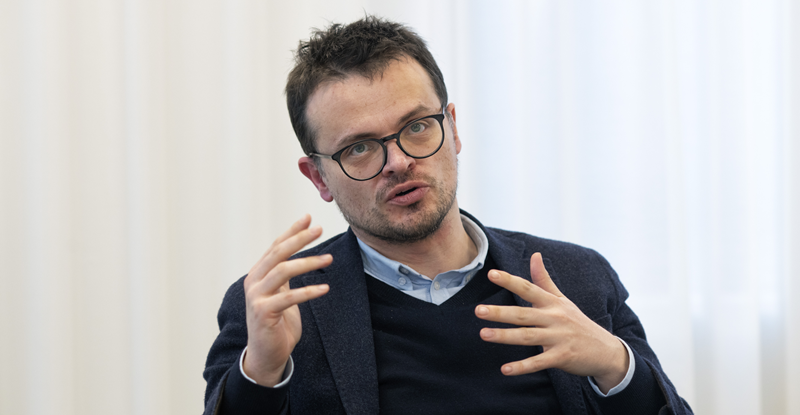
Context is crucial to understanding both how AI works and where its limitations lie. “The acceleration and value AI delivers lie primarily in what we can describe as codifiable knowledge. Yet, at this stage, that represents only part of what makes someone truly effective in their role.” Equally important is tacit knowledge: accumulated experience, know-how, the ability to navigate change, and the instincts developed over time. “These capabilities can only be codified to a limited extent today. A person’s ‘habitus’, or embodied expertise, is the result of a complex mix of education, professional experience, interactions, personal experiences, and even the environments in which they have lived.”
Alexander is anything but a technological pessimist. “The possibilities are enormous. Analyses and predictions can now be generated much faster and on the basis of far greater volumes of data. The real question, however, is what we do with those insights. In a world flooded with standardized data outputs, the true need is not for more numbers, but for meaning. Turning AI insights into real impact requires a deep contextual understanding across multiple dimensions, including the human sciences. These enabling conditions are often overlooked in discussions about AI.”
Navigating a rapidly changing landscape
This perspective also has strategic implications. “Your ability to understand and adapt to context is becoming more important than your ability to develop a long-term plan. A decade ago, organizations could still map out a detailed strategy for the next four or five years. Today, that is far less realistic. Even a plan drawn up in September for the year ahead can quickly become outdated.” The solution? “Scenario thinking and the ability to pivot quickly in response to changing circumstances.”
Your ability to understand and adapt to context is more critical than your ability to develop long-term plans.
At the same time, it is crucial to understand the underlying processes and ways of working, rather than focusing solely on the systems that support them, systems that are, by definition, tied to a particular moment in time. Large language models themselves are a telling example. “Today, GPT-6 Astra may be the latest breakthrough, tomorrow it will be another model. The landscape is constantly evolving. You cannot afford to anchor yourself to a single technology or tool. Instead, you need to build knowledge of both the tools and the underlying expertise, your professional domain, while developing the skills that enable you to navigate these changes with confidence and agility.”
Starting a career in an ageing workforce
From a demographic perspective, the flaws in the substitution narrative become even more apparent. “As the baby boomer generation retires, companies are also losing a vast amount of contextual expertise,” says Alexander Van Caeneghem. “At the same time, fewer new employees are entering the workforce, and young professionals have fewer opportunities to develop practical expertise.” He points both to the departure of potential mentors and to the disappearance of traditional entry-level roles. “The very tasks that once allowed graduates to gain experience and build their skills are the same tasks that AI is already capable of performing reasonably well today.”
In the age of AI, the ability to apply knowledge from one domain to another is becoming an exceptionally valuable skill.
The message is clear: invest in young talent, because organizations cannot afford to do without them. “We remain committed to developing talented individuals into the professionals they need to become. In practice, this means building finance expertise, fostering adaptability in the use of tools, and developing the skills required for what we call context architecture. What we do, designing solutions tailored to each client’s specific situation, is by definition a matter of customization.”
Learning on the job is the next stage. Before that comes higher education, where both study choices and, perhaps even more importantly, the structure of academic programs may need to be reconsidered. “Paradoxically, business and economics education may need a different calibration. Traditional concepts such as ‘practice-oriented learning’ require a sharper definition today, and that goes beyond semantics. To become effective professionals in the modern workplace, people need strong meta-skills that can be applied across different contexts. A broad intellectual foundation, built through a multidisciplinary framework and with greater emphasis on human and social science heuristics than on traditional applied knowledge, seems more relevant than ever.”
The future belongs increasingly to the neo-generalist. “In the age of AI, the ability to apply knowledge from one domain to another is becoming an exceptionally valuable skill.”

Change management as a culture, not a role
Human expertise will remain essential to the success of AI initiatives in the business world. This is precisely where many organizations continue to struggle. “The prevailing sentiment today is that the potential of AI and the expectations surrounding it still outweigh the value being realized in practice. Developing solutions that are effective, scalable, and economically viable has proven to be far more challenging than many initially anticipated.”
Does an increase in productivity also mean an improvement in quality, and what do you do with the time you save?
The fact that new innovations keep popping up during an implementation usually doesn’t help companies move forward. “They feel like they’re constantly playing catch-up.” Nevertheless, Alexander advises against throwing the baby out with the bathwater. “Two questions are essential here: Does a productivity gain also represent a qualitative gain, and what do you do with the time freed up? In other words: What kind of company are you, and what kind of company do you want to be?”
With such transformation processes, the question arises as to whether top management needs a change manager. “There’s certainly a case to be made for that, just as there is for HR as a full-fledged member of the executive board which is still far too rarely the case. At the same time, I think that constant change requires more than just a separate role or responsibility. Ideally, change management is embedded in all areas of responsibility, not merely as an attitude or point of focus, but as concrete expertise.”
This article originally appeared in Dutch on the House of Executive website. TriFinance is a partner of the Executive Forum 2026.


