
Data and systems are essential for the further development of Finance, but are they given enough attention on the agenda?
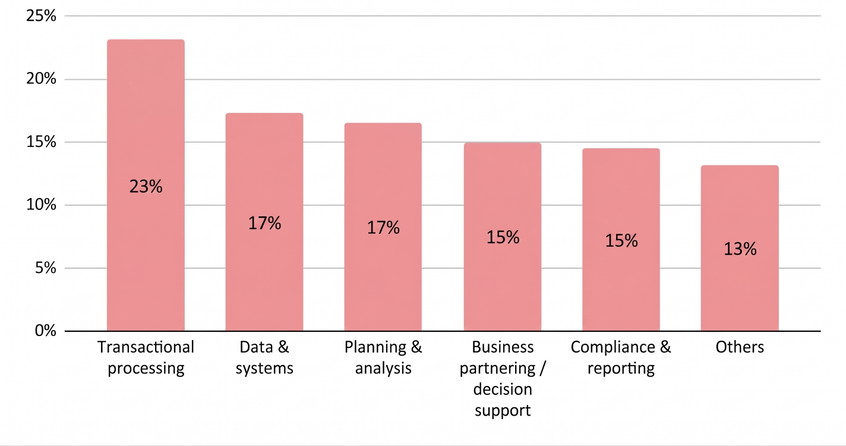
The TriFinance Barometer 2026, based on a survey of 138 respondents, shows that data management, tooling, and automation account for an average of 17% of the Finance team’s working time.
This puts these activities in second place in terms of time spent within Finance, behind transactional processing (23%), and on par with planning & analysis. Nevertheless, nearly three-quarters of respondents (72%) say that the Finance team spends a maximum of eight hours of their work time on these activities. For the largest group (38%), this amounts to four to eight hours per week, based on a 40-hour workweek.
Actual time spent in Finance:
When asked about the expected changes in how time is spent within Finance over the next three to five years, 45% indicated that the time spent on data and systems will remain the same. However, nearly as many respondents expect an increase (32%) or a significant increase (12%) in the time spent on data and systems. Combined, 44% expect these activities to require more time. This points to a growing need for data, tools, and automation within Finance.
How will the allocation of time within Finance evolve?
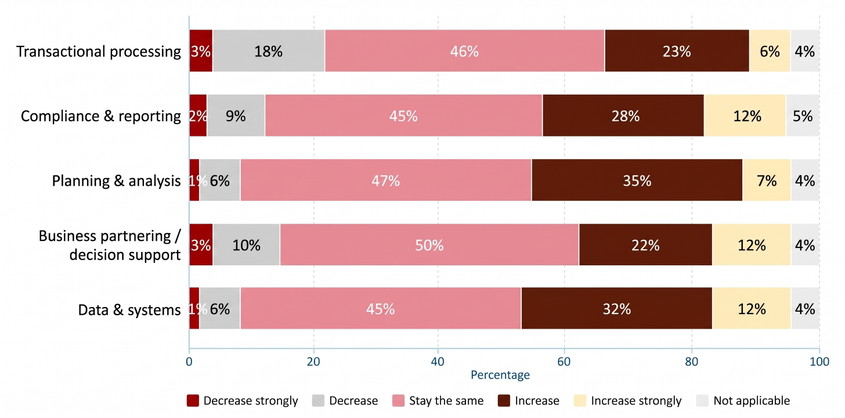
The broader trends within Finance confirm this picture. For planning and analysis as well, 42% of respondents expect the time spent on these activities to increase or increase significantly. For compliance and reporting, that figure is 39%. Transactional processing, on the other hand, stands in contrast: only 29% expect more time to be spent on this area. These expectations thus point to a shift toward more data- and analysis-driven activities, without the operational foundation of Finance disappearing.
For management, this raises a strategic question: if Finance wants to work in a more data-driven way and fully leverage the potential of automation, is investing in technology sufficient, or must time, capacity, and responsibilities also be structurally allocated to realize those ambitions?
In this article, we examine how Belgian organizations are handling systems and transformation, and to what extent their ambitions align with daily practice.
Satisfaction with financial processes and systems
A clear gap between roles
The TriFinance Barometer 2026 shows that satisfaction with current financial processes and systems varies depending on the respondents’ roles.
Striking differences are evident between C-level executives and senior management, as well as between strategic decision-makers and professionals who work with the systems on a daily basis. These results may point to a fundamental difference between the strategic assessment of financial systems and the operational experience with them. While management focuses primarily on the contribution of systems to efficiency, control, and transformation, employees also experience the limitations of existing processes and tools in their day-to-day work.
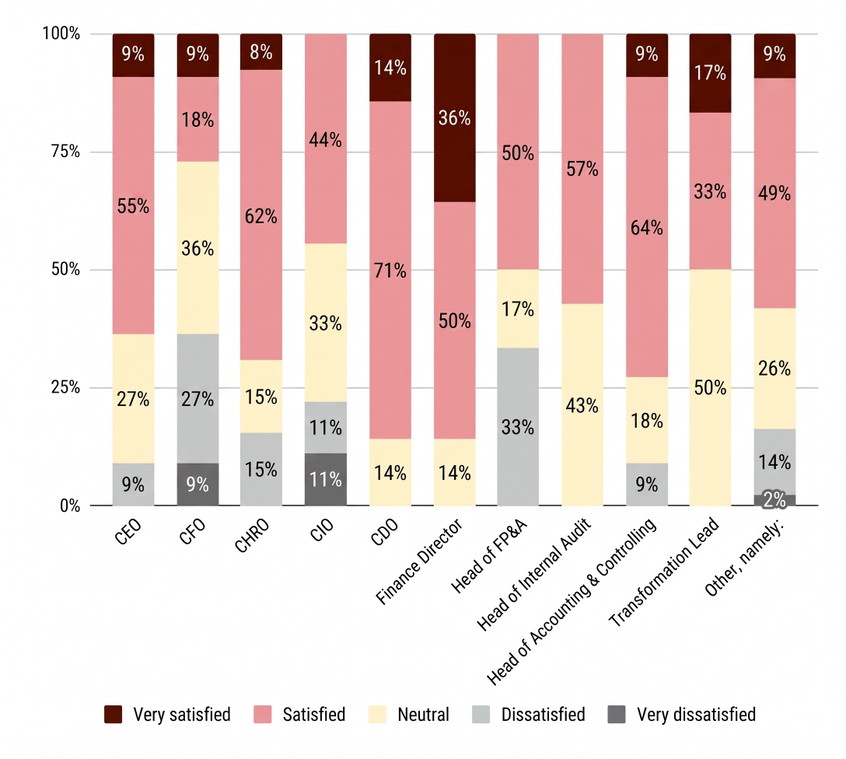
How satisfied are you with the functioning of the current financial processes and systems in your organization?
Senior Management: local optimization vs. day-to-day challenges
Senior management generally views the performance of systems more positively than C-level executives. For example, the combined satisfaction rate (satisfied or very satisfied) is 86% among Finance Directors and 73% among Heads of Accounting & Controlling.
This may be explained by the fact that senior management more often evaluates systems based on how well they support their own function. For them, reports, budgets, and processes must contribute to the achievement of departmental objectives. For example, it is conceivable that a department has good tools and workable, locally optimized processes, resulting in high satisfaction, while broader integration with other departments or systems is less effective.
At the same time, the picture within this group is not entirely positive. For example, 33% of FP&A heads are dissatisfied, which suggests that satisfaction varies depending on the processes for which they are responsible. After all, functions such as FP&A and Accounting & Controlling are closely tied to day-to-day operations. They are constantly confronted with concrete operational challenges, such as manual corrections, inconsistent definitions, and time-consuming reconciliations.
The C-suite and its different perspectives on the same reality
There are also clear differences within the C-suite, which can be explained by the specific responsibilities and expectations associated with each role:
- The CDO (85% satisfied or very satisfied) focuses primarily on data and information. The CDO ensures that data is widely available for analysis and decision-making. This can result in a (high) level of satisfaction, even when the underlying financial processes are inefficient.
- The CHRO (70% satisfied or very satisfied) focuses mainly on supporting HR processes, such as the usability of personnel budgets and HR reports (engagement, rewards, learning & development, etc.). If that support is adequate, the CHRO remains shielded from operational pain points in, for example, the financial chain.
- The CEO (64% satisfied or very satisfied) focuses on business results and decision-making. As long as the final reports and key figures are useful for steering the company, the systems are likely functioning properly in the CEO’s eyes. The enormous operational effort behind the numbers (such as manual corrections and data fragmentation) is often less visible to the CEO.
- The CIO is an exception to this positive trend: no one reports being very satisfied, and 11% are dissatisfied, which may indicate a keener awareness of the technological complexity and integration issues behind the scenes.
The CFO as the critical voice
The CFO stands out as the most critical voice among C-suite executives. Only 27% of CFOs are satisfied or very satisfied with financial processes and systems, while 36% are dissatisfied or very dissatisfied. The group of dissatisfied CFOs is thus larger than the group of satisfied CFOs. This points to a clear gap between the expectations of the chief financial officer and the actual functioning of the current environment. While a system may function adequately for an individual department or the CEO, it falls short for the CFO in terms of organization-wide coherence. After all, the CFO assesses the quality and reliability of the entire financial information chain.
Four factors are likely to carry significant weight in this regard:
- Risk management: The CFO bears ultimate responsibility for the reliability and auditability of financial figures. Problems that are manageable for other users pose a substantial risk to the CFO.
- Pressure for efficiency: Processes must not only function but also be scalable and cost-effective. Consequently, a high volume of manual tasks carries extra weight in the CFO’s assessment.
- System fragmentation: When ERP, reporting, and planning systems do not integrate sufficiently, it is impossible to create a single source of truth.
- Strategic guidance: The CFO is increasingly expected to look ahead and provide strategic advice. Systems that support only historical reporting do not meet this modern need.
Different realities within a single organization
Satisfaction with systems is not evenly distributed. The figures and underlying hypotheses show that an organization can simultaneously exist in different realities:
- General management has access to information that is useful enough to make strategic decisions.
- Meanwhile, the Finance function is under considerable pressure and must make an operational effort to produce that information in a timely, accurate, efficient, and verifiable manner.
- Those responsible for data, technology, and change each see a different specific part of the puzzle and the bottlenecks.
This discrepancy warrants further analysis. It suggests that the challenge in the organizations in question does not necessarily lie in a lack of systems, but rather in the quality of cohesion, integration, and data quality across the entire chain. This insight provides a clear starting point for identifying where process improvements or system upgrades can deliver the most value.
Financial Systems: The gap between ambition and reality
The differences in satisfaction we observe in the survey results make it clear that the quality of financial systems depends not only on how they function for individual users, but also on the extent to which they support the organization as a whole.
The crucial question, therefore, is whether existing systems and processes contribute sufficiently to better decision-making, and whether organizations are willing to invest in the optimization required to achieve this. The survey results point to a tension between the need for improvement, planned investments, and the obstacles that are slowing down the transformation.
Limited impact on strategic decision-making
It appears that financial reporting and analysis still do not sufficiently support strategic decision-making. Nearly two-thirds of respondents (64%) indicate that this support is limited. Only 22% believe that reporting and analysis contribute significantly to strategic decisions; 9% say they offer no support at all. This highlights the need to better translate financial information into insights that guide corporate strategy.
Optimization is needed, but investments remain limited
The need to optimize financial systems and processes is clearly evident: 42% describe this need as high or critical, compared to just 11% who consider it low or not urgent. Yet planned investments lag behind this need. Only 17% indicate that significant investments are planned for the integration or further rollout of financial systems. For 59%, those investments remain limited, and 15% say no investments are planned. The figures thus suggest a potential gap between the perceived need for optimization and the resources being allocated to address it.
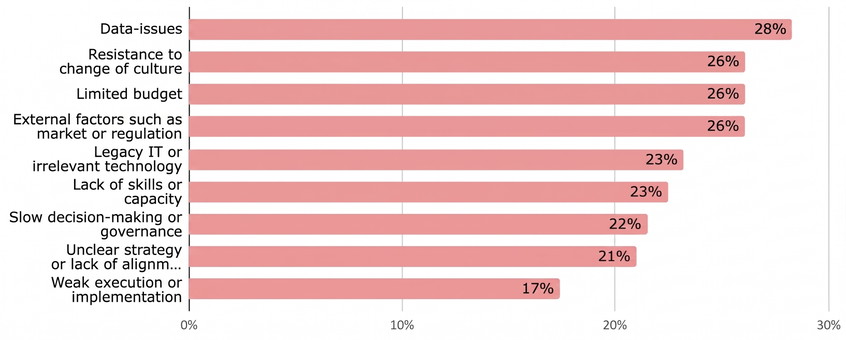
Looking at the transformation agenda for 2026 in the area of finance, what are the key bottlenecks?
Data, people, and resources as the main obstacles
The biggest bottleneck on the Finance transformation agenda for 2026 is data issues, cited by 28% of respondents. In addition, resistance to change or cultural issues, limited budgets, and external factors such as market developments or regulations each were cited by 26% of respondents. Legacy IT or technology that is no longer relevant (23%), a lack of skills or capacity (23%), and slow decision-making or governance (22%) also pose significant obstacles. The challenges are therefore not exclusively technological: culture, funding, expertise, and decision-making also determine how smoothly the transformation progresses.
From system investment to tangible business value
Ultimately, the results reveal a significant challenge for management. According to most respondents, financial reporting and analysis still provide insufficient strategic support, while the need for optimization is great and investments often remain limited.
At the same time, persistent data issues and organizational obstacles make the transformation more complex than a purely technological issue. For organizations, the challenge in 2027 therefore lies not only in renewing or integrating systems, but also in improving data quality, strengthening skills, and securing sufficient budget, buy-in, and clear governance.
Only in this way can financial systems evolve from supporting infrastructure into a full-fledged driver of better decision-making and business management.


