
The Belgian labor market finds itself in a paradoxical situation: despite economic fluctuations, the labor shortage remains at historically high levels. The latest reports from the VDAB, Actiris, and Forem confirm that the structural shortage of specific job profiles is not abating but is becoming more complex.
A survey conducted by TriFinance in the summer of 2026 among C-level executives and senior management at companies based in Belgium reveals that, due to a lack of capacity, organizations are having to postpone or cancel initiatives such as ERP implementations, data and analytics initiatives, compliance projects, and process optimizations.
A capacity shortage within Finance is not just a staffing problem: it can also slow down organizations’ strategic agendas. The survey shows that various issues—such as recruitment time, limited budgets, and unexpected absences are intertwined, and that executives assess these causes very differently.
Capacity as a barrier to change and progress
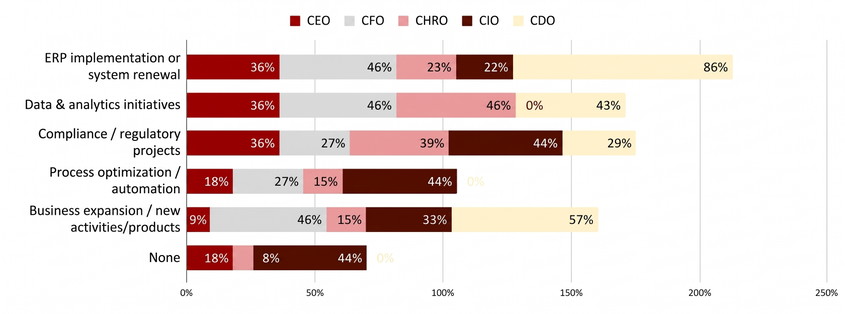
The impact of capacity shortages varies by role or is perceived differently depending on the role, but the signs are clear: for example, eight out of ten CDOs surveyed indicated that ERP implementations or system upgrades were delayed. Nearly half of the CFOs reported the same. An equal number of CFOs and Chief HR Officers cited data and analytics initiatives. In addition, four in ten CIOs cited compliance and regulatory projects, as well as process optimization and automation.
Among senior management, slightly more than half of the heads of Accounting & Controlling reported delays in data and analytics initiatives. And among the heads of FP&A, seven out of ten respondents noted that both compliance projects and process optimization or automation came under pressure.
Which strategic initiatives has your organization had to postpone or abandon over the past year due to a lack of capacity within Finance?
Capacity shortages: causes
Behind these figures lies a combination of hard-to-fill vacancies, budget constraints, unexpected absences, and long recruitment times. When asked about the main causes of capacity problems, respondents cited, first and foremost, unforeseen absences due to illness and/or resignations, followed by hard-to-fill vacancies and budget constraints.
Here, too, we often hear different explanations for capacity issues depending on the role. Different stakeholders have different explanations and perspectives on the very same issue, suggesting that this is not a single, isolated recruitment problem.
What were the main causes of the capacity issues in your organization?
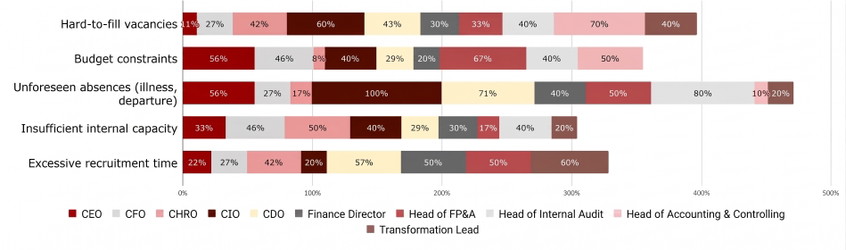
For CEOs, budget constraints and unforeseen absences are the main factors (both at 56%), while CFOs emphasize both budget constraints and a lack of internal capacity (both nearly half). Among CIOs, unforeseen absences stand out: all surveyed CIOs cite this as a cause, along with hard-to-fill vacancies (six in ten). Absences also weigh heavily among CDOs (seven in ten), but more than half (six in ten) also point to long recruitment times.
The latter also represent a major bottleneck for Finance Directors and FP&A heads (both half) and Transformation Leads.
The tight labor market is particularly evident in Accounting & Controlling: seven out of ten managers cite vacancies that are difficult to fill, the highest percentage among the group surveyed. FP&A managers, on the other hand, primarily point to budget constraints, while Internal Audit managers often report unforeseen absences.
The figures thus paint a picture of a twofold problem: organizations must fill vacancies while simultaneously ensuring the continuity of their teams, even as budget constraints in some roles further limit their ability to bring on additional staff.
It is worth noting that budget is not the biggest obstacle for everyone: it is cited primarily by FP&A heads (67%) and CEOs (56%). There is therefore no single, uniform solution: the figures point to a variety of bottlenecks, not to a single universal cause.
The broader labor market context
In a labor market where specialized professionals in finance, data, and technology are not always easy to find, the question is becoming increasingly urgent: How can organizations build sufficient capacity to ensure their day-to-day operations and realize their transformation goals?
The broader labor market context helps explain why this is not a simple recruitment issue. The Flemish labor market will be slightly less tight in 2026, but structural bottlenecks will persist. The VDAB’s 2026 list includes 227 shortage occupations, including, for example, accountant. The VDAB points not only to a shortage of candidates but also to a mismatch between the skills and experience employers are seeking and what candidates can offer.
In finance, this is compounded by the growing need for a combination of financial expertise, data insight, and technological knowledge. The latter is also evident from the survey results. It is therefore not merely an observation based on the list of shortage occupations. Above all, the figures make it clear that organizations must not only compete for scarce talent but also consider how to deploy existing employees, develop knowledge internally, and align their transformation goals with the capacity that is actually available.
Temporary profiles or permanent profiles?
How difficult is it to complete financial profiles within your organization?
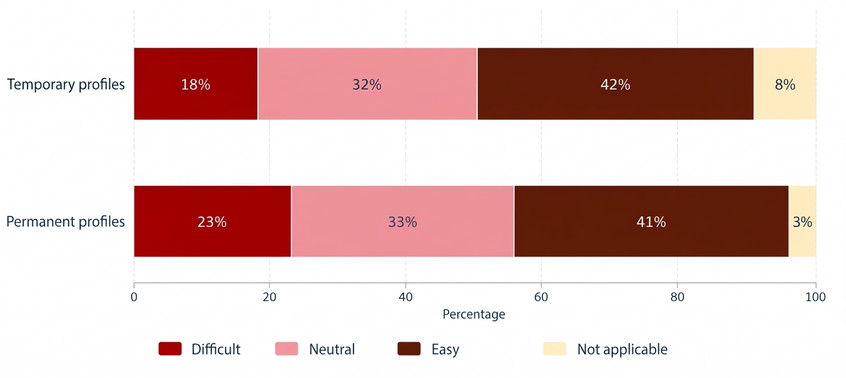
For organizations based in Belgium, attracting finance professionals seems to be relatively easy for now, but the process is more difficult when it comes to permanent hires. For example, 42% of respondents describe filling temporary positions as easy, compared to 18% who find it difficult. The situation is different for permanent positions: 41% find them easy to fill, while 23% experience difficulties. The differences aren’t huge, but they indicate that permanent hires present slightly more challenges than temporary assignments.
This appears to be consistent with general market observations. The job market for accountants and finance specialists will still be extremely tight in 2026. According to the VDAB, the average processing time for a general, non-specialized employee (such as a data entry clerk, receptionist, or general administrative assistant) is 2 to 4 weeks. For a qualified bookkeeper (accountant, file manager, or general ledger accountant), the average time to fill a position in 2026 will be 4 to 8 weeks (or longer). Financial roles have been among the most persistent shortage occupations in Belgium for years.
On average, how long does it take to fill a temporary finance position?
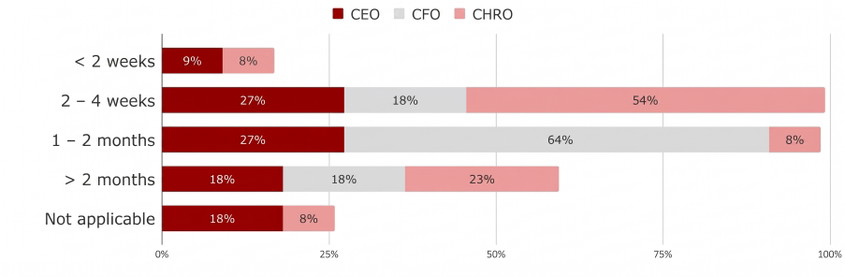
When we look at how the various C-level executives perceive the recruitment of finance professionals, the responses differ by respondent group here as well.
- Among CFOs, 64% indicate that filling a vacancy typically takes one to two months; another 18% report a timeframe of two to four weeks, and 18% report more than two months.
- Among CHROs, the majority (54%) estimate the turnaround time at two to four weeks.
- For CEOs, the picture is more varied: 27% cite two to four weeks, and an equal number of CEOs indicate one to two months.
On average, how long does it take to fill a finance position?
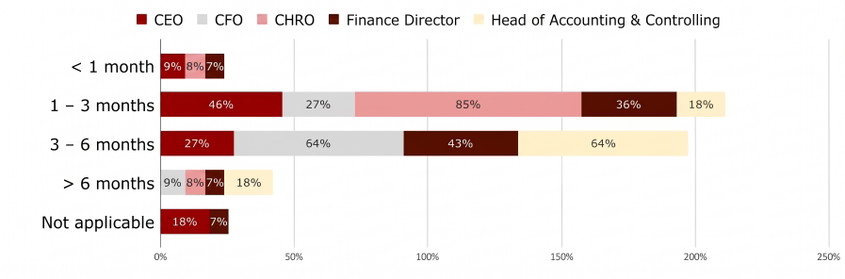
When it comes to permanently filling a position, 64% of CFOs report a timeframe of three to six months. The same applies to 64% of Heads of Accounting & Controlling; among Finance Directors, 43% cite that timeframe.
In any case, the figures make it clear that organizations must take into account in their capacity planning that hiring processes can take several months.
Temporary staffing as a strategic lever
Temporary staffing appears to be primarily a solution for urgent capacity shortages: 36% of respondents bring in external professionals for this purpose. Temporary projects (27%) and bridging the gap during the recruitment process (23%) are also key motivations.
Why do organizations opt for temporary staff?
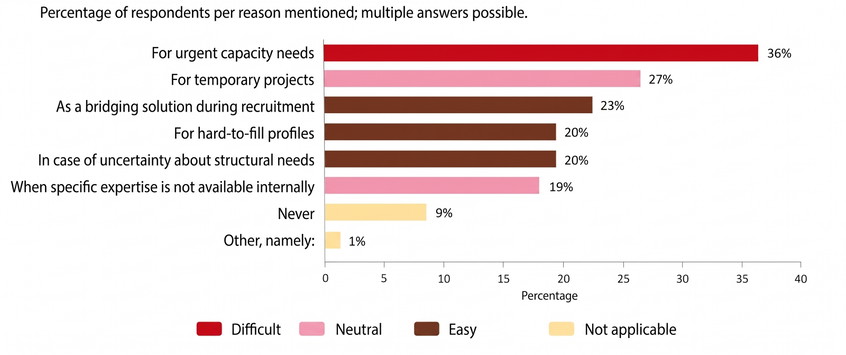
In addition, the scarcity of hard-to-fill positions plays a role (20%), as do uncertainty about long-term staffing needs (20%) and the lack of specific in-house expertise (19%).
The speed with which external professionals can add value is also relevant here: 63% of respondents indicate that external professionals can be fully operational within one month and deliver measurable value with limited guidance. For 30%, this can even be achieved within one to two weeks, and for 33%, within a month. At the same time, 22% need more than a month.
How quickly can an external professional become fully operational within the Finance Team and add measurable value with limited guidance?
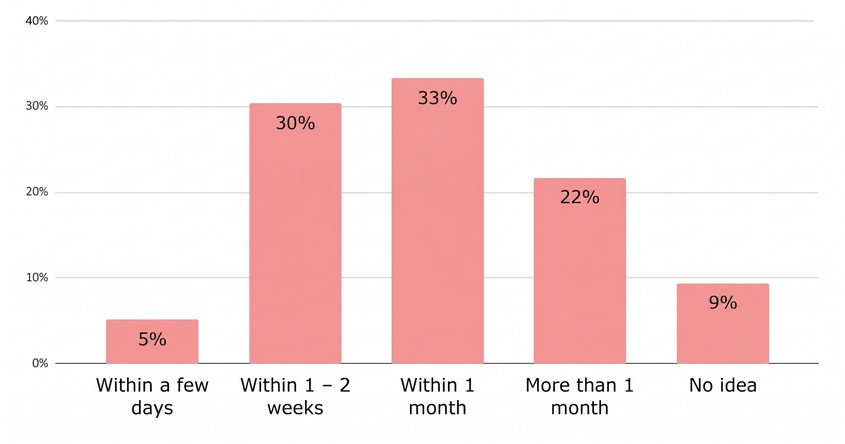
Temporary staff can therefore quickly provide additional capacity, but the speed at which this happens also depends on how smoothly an external professional can be integrated into the team and its operations.


