
The average CFO at organizations based in Belgium does not yet seem to have fully broken free from the traditional finance machine. The TriFinance Barometer shows that transactional processes, month-end closing, and reporting are on the agenda for virtually everyone, although for 82% of respondents, these tasks account for no more than 10% of their time.
At the same time, CFOs devote some time to performance management. For a small majority (55%), this accounts for up to 10% of their time, which is primarily spent on budgeting, forecasting, and monitoring results. A comparable amount of time, albeit among a smaller group of CFOs (46%) is devoted to strategic advice and supporting decision-making for the board of directors and the executive committee, while 36% allocate between 11% and 30% of their time to these activities.
Time spent of the CFO:
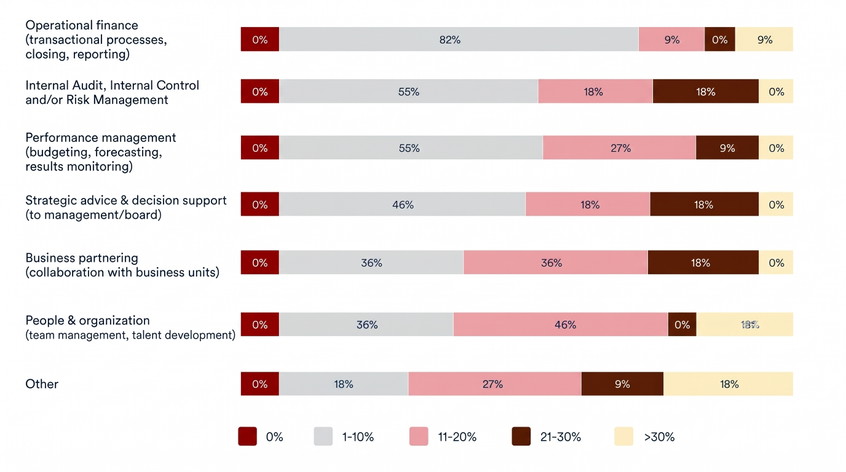
Business partnering accounts for a larger share of some CFOs’ time: 54% spend 11–30% of their time on this. People management also requires significant attention: for 46%, it takes up 11–20% of their time.
In addition, there is the broader responsibility for internal audit, internal control, and risk management. The amount of time spent on these areas also varies considerably: for a majority of 55%, the time spent is limited, but for some CFOs, it amounts to 20% or more.
The picture is therefore not clear-cut in terms of CFOs being overwhelmingly involved in operational tasks. However, the role of CFOs varies greatly depending on the context in which they operate. They often combine a wide range of responsibilities, from day-to-day financial operations to strategic advising, business partnering, and leadership. The exact balance of these responsibilities varies from organization to organization.
Strategic decision-making is part of the role, but not every CFO takes on the same level of involvement
The figures on CFOs’ involvement in specific areas confirm that strategic decision-making is part of the CFO’s mandate, but also reveal differences in the extent to which CFOs themselves take on a role in this process.
27% of CFOs are fully involved in strategic decision-making and 36% are partially involved, totaling 63% of respondents. For 9%, involvement is limited, and 27% say they are not involved at all.
To what extent is the CFO involved in the following areas:
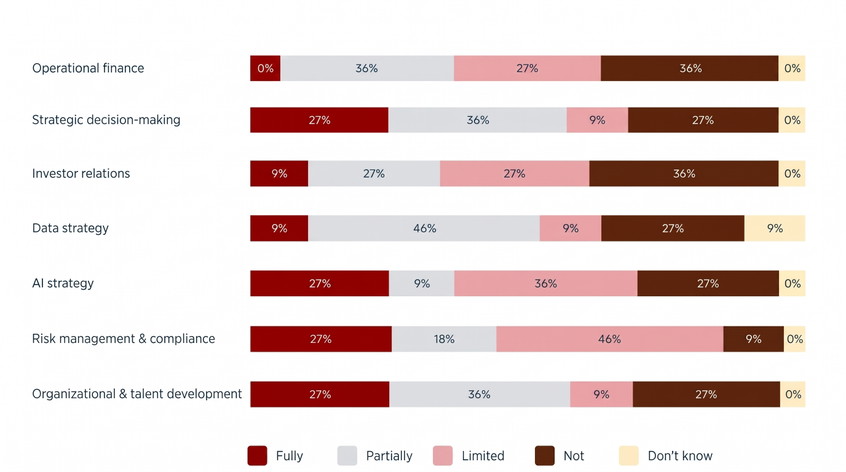
This is an important nuance to the all-too-common cliché of the CFO as a strategic co-pilot. The role does not automatically place the CFO at the center of strategic decision-making. For a significant group, involvement is full or partial, but for more than a third, involvement in strategy is limited or even entirely absent.
This aligns with the findings on time allocation. Although CFOs set aside time for strategic advice and decision support, nearly half devote no more than 10% of their time to these activities. The figures suggest that the strategic role depends not only on the CFO’s formal position but also on how responsibilities and decision-making are distributed within the organization.
Data and AI are on the agenda, but the level of involvement varies
The picture is also nuanced when it comes to data and AI strategy. Regarding data strategy, 9% of CFOs are fully involved and 46% are partially involved. For 9%, involvement remains limited, while 27% indicate they are not involved. 9% are unsure.
The pattern is different for AI strategy. 27% of CFOs are fully involved, but 9% are only partially involved. For 36%, involvement remains limited, and for 27%, it is completely absent.
The comparison reveals an interesting finding. When it comes to data strategy, CFOs most often indicate that they are partially involved. With regard to AI strategy, the group that is fully involved is larger, but at the same time there is a significant group that is only limitedly involved or not involved at all. There is therefore no homogeneous profile of the CFO as the owner of the digital agenda.
However, if we aggregate the results and examine the ratio of CFOs who are fully or partially involved versus those who are only limitedly involved or not involved at all, the picture becomes clearer.
When it comes to data strategy, 55% of CFOs are fully or partially involved, compared to 36% who are only partially or not at all involved. For AI strategy, 36% are fully or partially involved, compared to 64% who are only partially or not at all involved.
Involvement CFO in data and AI strategy:
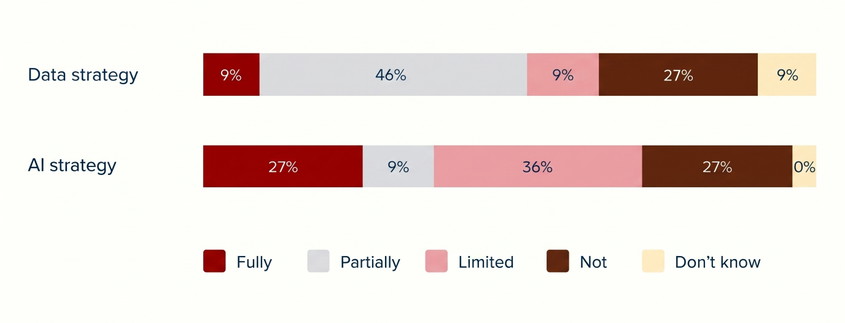
The CFO therefore finds it easier to align with the data strategy than with strategic decisions regarding AI. Data aligns directly with Finance’s familiar role in reporting, analysis, and decision-making. AI strategy seems less naturally part of Finance’s domain, or is more strongly influenced by other functions.
CFOs therefore seem to be more frequently involved in the question of how data is used than in the question of how AI is strategically developed and applied.
This is not illogical: the CFO can help guide the application of AI without necessarily being the owner of the AI strategy. After all, AI is organization-wide: it affects not only Finance, but also IT, operations, HR, sales, and overall business strategy.
A data strategy is therefore directly aligned with finance’s role in reporting, analysis, and decision-making. An AI strategy has a broader scope and is likely to be shaped by multiple functions and disciplines across the organization.
Risk management is widely practiced, while investor relations is less common
In virtually all organizations, the CFO is involved to some extent in risk management and compliance. 27% of respondents report full involvement, 18% partial involvement, and 46% limited involvement. Only 9% indicate that the CFO is not involved.
This indicates an area in which the CFO typically plays a role but does not necessarily assume day-to-day or central responsibility. The relatively large group with limited involvement suggests that risk management and compliance are often also handled by other functions. The CFO therefore does not need to directly manage all activities to still have responsibility for or oversight of them.
In the area of investor relations, the level of involvement is less pronounced. Only 9% of CFOs are fully involved, and 27% are partially involved. For another 27%, involvement remains limited; 36% indicate they are not involved.
Investor relations therefore does not appear to be an area in which the CFO naturally plays a central role in every organization. This may be linked to how this responsibility is allocated within the organization, although the survey does not provide conclusive explanations. What the figures do show is that the CFO’s role in this area varies considerably from one organization to another.
The strategic CFO and the organizational context
The results of the TriFinance Barometer reveal a broad CFO role, but not a uniform profile. Strategic decision-making and business partnering receive significant attention from some CFOs, while involvement in data, AI, risk management, investor relations, and organizational development varies considerably. Operational finance also remains a key focus for some CFOs, whereas others are more removed from these activities.
The organizational context appears to play an important role. Organizational size is one potential differentiating factor: as organizations grow and the finance function becomes more extensive, CFOs may have greater scope to step back from operational responsibilities. The composition of the finance department also matters. Where CFOs have larger teams at their disposal and tasks are more specialized or delegated, they seem better able to reduce the operational demands on their own time.
Digitalization can further expand this capacity. A finance function with streamlined processes, reliable data availability, and well-integrated systems creates more opportunities for CFOs to focus on analysis, performance management, and decision-making.
The strategic CFO therefore emerges not merely because an individual holds the title or possesses the ambition, but because the organization creates the space and grants the mandate required to fulfil that role.
The way an organization structures its finance function, embraces digitalization, and allocates responsibilities ultimately helps determine how much room the CFO has to operate as a genuine strategic partner.


