
Ask any CFO about artificial intelligence, and the narrative is familiar: vendors promise overnight efficiency, and the board expects immediate headcount reductions. Meanwhile, there is growing bottom-up pressure from finance professionals pushing for AI tools to eliminate routine work, even while quietly worrying about their own job security.
But rushing into AI pilots without evaluating your foundation often leads to expensive failures and internal pushback.
So, what does AI readiness in finance actually mean?
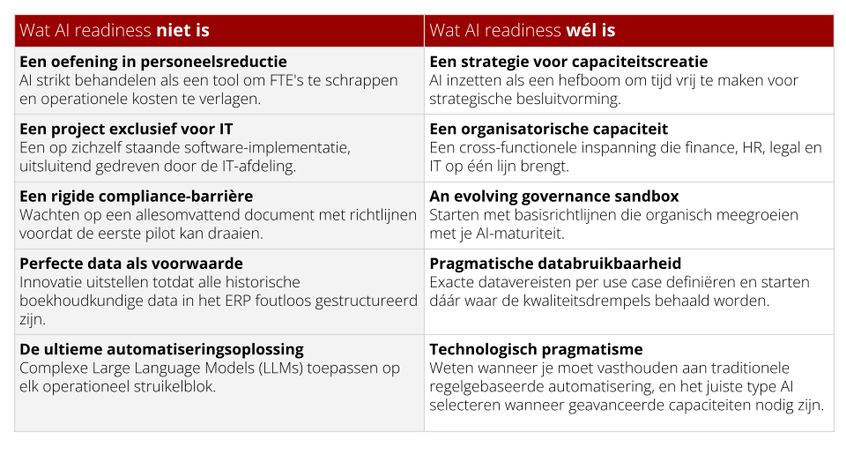
True AI readiness is not a simple IT threshold or a quick efficiency hack to downsize your team. It is a continuous organizational capability that aligns your processes, systems, data, governance, and—crucially—your people. Instead of treating AI as a substitute for financial expertise, you need to leverage it as a force multiplier to drive strategic impact.
In this article, we cut through the market hype. We explore what genuine AI readiness means, how to build an effective AI operating model, and why strengthening human potential is the actual key to transforming efficiency gains into lasting strategic value.
Why a failed AI pilot costs more than the pilot
When looking at most AI in finance initiatives today, we see a predictable pattern: there is a large gap between initial expectations regarding accuracy or efficiency gains, and the actual results in practice. This rarely has anything to do with software capabilities. Instead, the explanation lies in how organizations approach AI adoption in general, coupled with mismatched expectations regarding what specific types of AI can actually deliver.
The pitfall of executive urgency and market hype
Finance leaders face a complex dynamic. When boards initiate conversations about artificial intelligence, the underlying expectation is often immediate cost reduction. Combine this with vendors pitching "out-of-the-box" tools that promise instant transformation, and the pressure to deliver quick wins builds rapidly.
This environment often traps finance functions in a defensive stance. However, viewing AI solely through the lens of cost reduction overlooks its real value as a strategic asset for capacity and insight.
When the board asks about headcount reductions, the conversation needs to pivot from cost-cutting to capacity creation. The core argument should be: Which high-value strategic questions, scenario analyses, and commercial insights are we failing to deliver today due to a lack of time? And how can AI free up the operational capacity to finally address them?
Adopting an AI solution just to show action, without evaluating your underlying processes and redefining your team's focus, does not unlock this strategic depth. It simply pushes your organization into a finance process automation trap.
Blaming the wrong culprit: why failed AI pilots are rarely a technology issue
When rushed pilots fail to deliver upon their promises, the technology is the easy one to blame.
Pointing at the wrong culprit leads to a dangerous conclusion: writing off artificial intelligence as overhyped, freezing further innovation, and returning to the old way of working.
In reality, AI didn't fail, but the readiness was missing. Many failures stem from forcing hyped technology, like LLMs, onto workflows that actually require predictive analytics or simple deterministic automation. True readiness means having the insight to match the exact financial problem to the correct technology.
To avoid this pitfall, finance leaders need a structured method to build an AI-ready organization before committing resources to a pilot. This is where a framework to assess and build AI readiness becomes indispensable.
Rather than viewing readiness through a narrow IT perspective, a robust AI framework builds the necessary operational, human, and governance foundations first.
Redefining AI readiness as an organizational capability
Transforming finance with AI cannot happen in isolation, nor can leadership adopt a hands-off approach, expecting finance professionals to navigate this transition alone. Before any tool can deliver real value, management must actively sponsor and guide the initiative rather than treating AI readiness as a purely operational task. True organizational AI readiness goes far beyond the finance department. It requires breaking down functional silos to ensure IT, HR, legal, and operational leadership move in the same strategic direction.
Viewing readiness as an organization-wide capability prevents your organization from falling into the trap of localized quick fixes. Conducting a structured AI readiness assessment forces leadership to evaluate how systems, processes, and people align with overall business strategy before committing capital to vendor solutions.
Governance as an enabler: the AI framework
Effective governance does not slow down innovation. On the contrary: it provides the foundation for scalable progress. Rather than restricting momentum, a clear AI framework serves as the structural foundation for your broader AI operating model, giving teams the clarity and confidence they need to experiment safely.
However, treating governance as a binary prerequisite (assuming you need a fully finished, comprehensive rulebook before writing your first prompt) is a common mistake. Establishing a clear AI policy is an essential first step, but it shouldn't become a bureaucratic bottleneck that restricts innovation. Just as your organization's AI maturity grows over time, your framework should evolve alongside it. To get started, you need a pragmatic policy that sets solid guardrails without limiting exploration and creativity. A strong first version simply clarifies the essentials: which tools are approved, what type of data can be shared, and who signs off on the output.
By outlining these guardrails from day one, you create a transparent sandbox for experimentation. When your finance professionals understand exactly what is allowed, they can freely explore personal productivity tools and workflow improvements without fear of non-compliance. As new and more complex AI use cases for finance arrive, your governance scales with them, but not before.
This structured, step-by-step approach transforms scattered, individual enthusiasm into coordinated, enterprise-wide value, building a repeatable capability aligned with your strategic business priorities.
Operational pragmatism: matching technology to financial workflows
A key indicator of an organization's AI maturity—built around a robust AI governance framework—is the capability to make pragmatic technology choices. True AI readiness does not mean applying artificial intelligence to every bottleneck. Instead, it gives finance functions the necessary insight to match the right solution to the specific problem, distinguishing between strict, rule-based automation and flexible AI capabilities.
Knowing when to use AI vs. traditional automation
Artificial intelligence is not a universal solution for every process bottleneck. If a financial workflow relies on structured data and follows fixed, logical rules, standard ERP functionality or traditional Robotic Process Automation (RPA) remains the most efficient, cost-effective, and accurate solution.
For instance, automated straight-through processing for standard invoices with matching purchase orders does not require a Large Language Model (LLM). It simply requires clean business logic built into your core systems.
Part of AI readiness is knowing to reserve machine learning for unstructured inputs, pattern detection, variance forecasting, and complex scenario modeling. To handle deterministic, high-volume transactions on the other hand, more traditional rule-based models still are your best pick.
The usability threshold for financial data
Evaluating data readiness for AI is another part of it. Delaying innovation until every historical ledger across legacy ERPs is flawlessly structured often leads to permanent paralysis. On the other hand, feeding AI with unreliable data leads you to the well-known data pitfall of “Garbage In, Garbage Out” (GIGO).
In this regard, achieving AI readiness means being able to clearly define what data is needed for a specific AI solution and to determine when the data quality is high enough to produce results that fall within the reliability parameters and error margins you have established.
It’s also realizing that data readiness for AI is not a passive waiting game; it is an active discipline that runs parallel to business initiatives. Finance teams can build data quality, governance, and structured pipelines directly alongside their initial functional use cases, ensuring that data improvements deliver immediate business value.
Take the AI readiness scan
The human core of AI readiness: why workforce capability matters more than technology
While leadership often focuses on technology and processes when reviewing the finance operating model in the age of AI, the human aspect is often overlooked. Yet, an AI operating model cannot exist without individual readiness across the workforce.
Shifting from technical mechanics to financial judgment
When personal computers first entered corporate finance, there was a widespread assumption that every accountant would need to become a programmer. We see a similar misconception today with artificial intelligence.
To achieve individual readiness, a financial controller does not need to master the code of a Large Language Model (LLM) or the statistical models behind predictive analytics. Instead, individual AI readiness means understanding the practical boundaries and capabilities of these technologies.
An AI ready professional knows what a specific model can and cannot do, understands the risk of it, and possesses the domain expertise required to critically validate outputs.
The future of finance does not belong to those who build algorithms, but to professionals who can interpret outputs, challenge flawed assumptions, and supply the commercial context that technology lacks. In this evolving operating model, finance professionals must remain firmly in the driver’s seat, treating AI as a high-powered navigation system rather than an autonomous driver. We must leverage AI to deepen our understanding of financial reality, never to outsource the burden of critical decision-making.
Capturing low-hanging fruit: starting with personal productivity
When finance departments think about AI, they tend to default to large-scale process automation or specific AI use cases for finance. Yet, the fastest ROI and lowest barrier to entry lie in exploiting the full potential of common AI tools for personal productivity.
Generative AI operates entirely through natural language, making it inherently accessible. However, many finance professionals only interact with tools like ChatGPT, Copilot, Gemini or Claude at a superficial level simply because they are unaware of what is already possible today within the applications they use daily.
Using basic but well-structured prompts to structure messy spreadsheet data, draft initial financial commentary, or build visual dashboards in minutes represents immediate efficiency gains. Organizations miss out on this low-hanging fruit when they fail to actively stimulate knowledge sharing on AI capabilities relevant for their business and prompting best practices. Encouraging team members to experiment with personal productivity gains through AI is the safest, most practical way to build organizational AI literacy before attempting complex implementations.
Putting people first: guiding teams through role evolution
When automation enters the workplace, your finance team will inevitably wonder whether technology will make their roles redundant. If employees view AI as a threat to their job security, they will quietly resist change and withhold the tacit knowledge required to make automated workflows succeed.
This is why you cannot manage digital transformation solely as a finance or IT project. As a finance leader, you must bring Human Resources to the table from day one. Effective AI change management is not a burden you should carry alone.
Instead of trying to figure out role evolution yourself, you need to actively partner with HR and ask them the critical questions: Who will assess the current skills gaps within the finance department? Who is going to design and facilitate the necessary training and enablement programs? And most importantly, how do we systematically build a culture of psychological safety?
To adapt to evolving financial roles, your team needs a safe environment to experiment, fail, and learn. By aligning with HR to answer these questions, you ensure a structured approach to this transition. Together, you make it unequivocally clear to your staff that technology is deployed to elevate human capability, not eliminate it.
The productivity delusion: redeploying capacity instead of cutting headcount
Thus, measuring the success of AI in finance is not about tracking hours saved, but all about directing where that newly created capacity goes. The real transformation happens when leadership changes the metrics of success from operational efficiency to business impact.
To make this shift tangible, stop reporting saved hours and start reporting what better, faster information actually changed: a forecast commercial teams could immediately act on, a margin erosion caught while it was still fixable, or a critical strategic question answered the same day.
Finance functions reaching higher tiers of AI maturity recognize that an operating model stripped of human expertise cannot drive sustainable growth. Technology should never serve as a substitute for human judgment, but as a force multiplier that allows finance professionals to evolve from number crunchers into context architects.
By deliberately redesigning your target operating model for finance, you ensure that reclaimed time translates directly into higher-value human output, reinvesting capacity straight into risk management, strategic scenario modeling, and commercial decision support.
AI readiness as an adaptive capability
Digital transformation in finance is still too often approached from a tool implementation perspective, as a project with a fixed deadline and a go-live date. In an era where the AI landscape evolves weekly, treating readiness as a static snapshot is a recipe for fast obsolescence.
True AI readiness is an adaptive, continuous capability that evolves alongside the technology itself. Our AI readiness scan and AI maturity model provide the structure and guidance needed to build your AI maturity step by step. It allows you to benchmark current capabilities, establish an AI framework clarifying governance while empowering employees to experiment within this sandbox.
By taking this iterative approach, you ensure your finance function moves past the market hype, avoids premature implementation failures, and builds lasting strategic value.
Take the next step in your AI journey
Evaluate where your organization and finance department stand, get a view of your AI maturity and tailored guidance on how to improve your AI readiness.


