
The initial results of the new TriFinance barometer confirm that Finance has been in a constant state of transition for years. Just as we’ve been hearing for nearly two decades that, for example, HR is claiming a seat at the executive table, the CFO has all along been expected to serve as a strategic co-pilot who sets the direction for the organization through forecasting, data-driven decision-making, and, more recently, AI adoption.
Processes have been standardized, at least on paper. Shared Service Centers (SSCs) have become a familiar pillar (only 8% of the surveyed companies say they do not use an SSC). The business’s expectations are sky-high.
However, the operational reality is at odds with this ambition. The question is no longer how much of Finance we should centralize, but whether the way Finance is currently structured still aligns with its strategic mandate.
The TriFinance Barometer 2026 does demonstrate that the traditional debate over centralization versus decentralization distracts organizations in Belgium from the real challenge: establishing an integrated value chain.
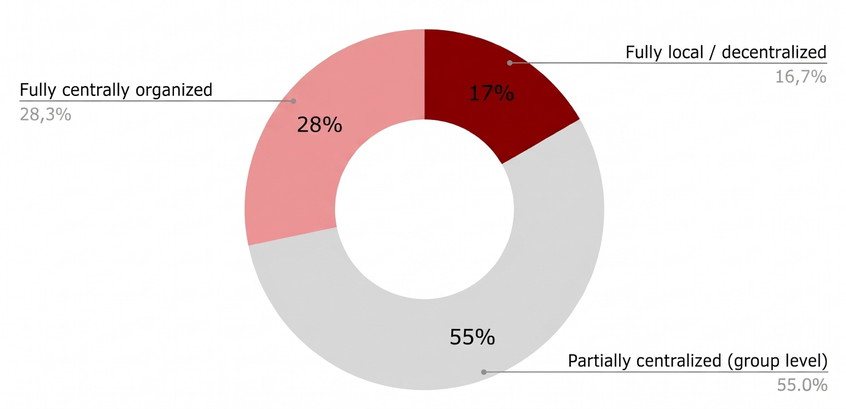
While 55% of respondents describe their Finance function as a hybrid, partially centralized model, the survey reveals deep frictions in process quality and a persistent capacity gap, with nearly 40% of valuable Finance capacity tied up in transactional processing (23%) and basic reporting (15%).
The organization of the Finance function:
1. The myth of centralized consensus
On paper, the direction of finance organizations seems indisputable: the purely local, decentralized model is less common than models with centralized control and hybrid forms. Only 17% of respondents report still having a fully local model, while 28% work in a company with a fully centralized finance department. At 55%, the hybrid model is the most common.
Behind this apparent consensus, however, lies a deep perception gap. How Finance is organized depends heavily on whom you ask:
- The C-Suite gap: As many as 73% of CFOs report working in an organization where the Finance department is partially centralized (at the group level), compared to just 39% of CHROs.
- The operational divide: 36% of Finance Directors work in a company with a fully centralized Finance function, while only 14% of Heads of Internal Audit do.
- The functional extremes: For 36% of the participating Heads of Accounting & Controlling, the structure is entirely local or decentralized, while none of the Heads of FP&A appear to work in an organization where Finance is organized entirely locally.
Organization of the finance function:
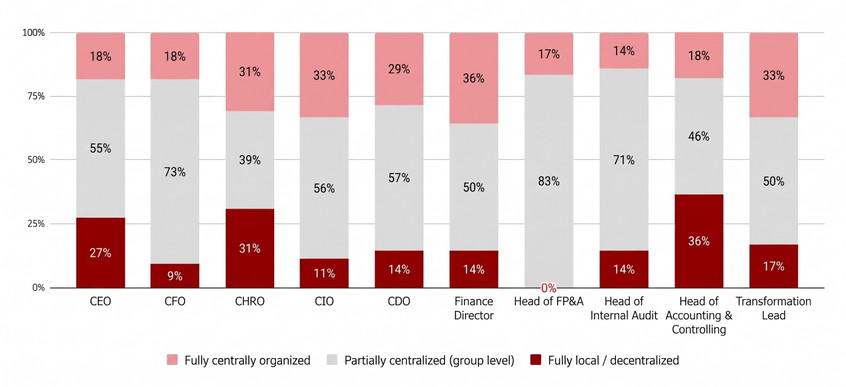
Although these samples are relatively small for each job category, they reveal a fundamental truth: different stakeholders experience the same organization in fundamentally different ways. A CFO oversees the macro-architecture, a controller runs into local exceptions, and an HR or IT leader looks at things purely from the perspective of systems and data.
When an organization makes decisions about centralization or outsourcing without aligning these divergent perceptions, blind spots emerge. An organizational structure may appear perfectly centralized on paper, but if data and information flows remain fragmented in practice, that centralization is nothing but an empty shell.
2. Centralization does not fix poorly performing processes
The promise of Shared Service Centers (SSCs) is clear: economies of scale, extensive standardization, and superior process quality. However, the TriFinance 2026 Barometer reveals a painfully counterintuitive picture: moving activities to a central location does not automatically lead to satisfaction. In fact, dissatisfaction prevails among traditional end-to-end transactional processes.
The gap is particularly stark in Order-to-Cash (O2C): 31% are dissatisfied, compared to a meager 16% who are satisfied. In Procure-to-Pay (P2P) as well, dissatisfaction (31%) significantly exceeds satisfaction (21%). Record-to-Report (R2R) is teetering on the brink, with a perfect stalemate of 25% satisfied and 25% dissatisfied.
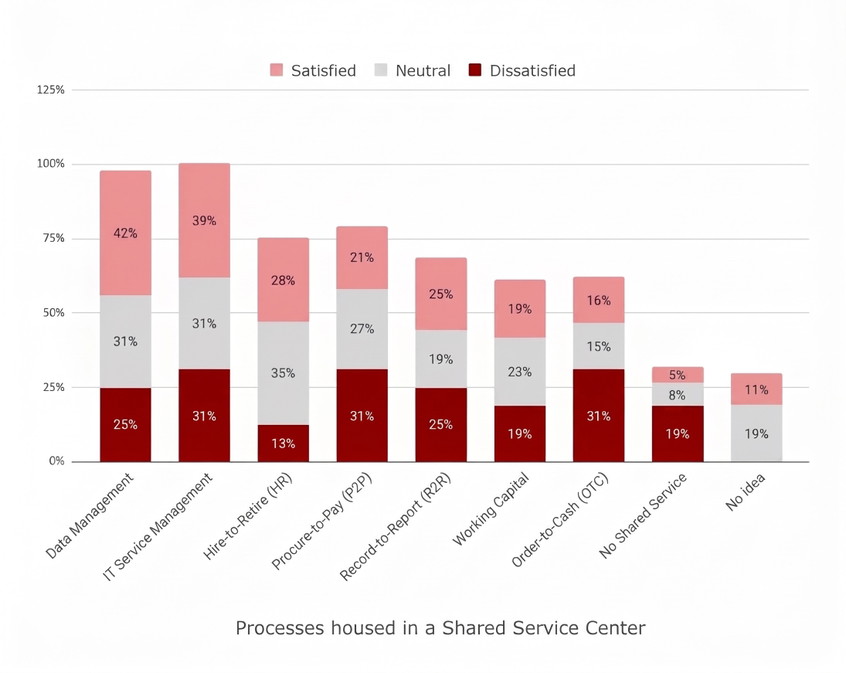
This proves that simply moving activities to a central hub does not eliminate friction, but merely shifts it. In fact, the friction shifts from the local entity to the SSC, or from Finance to IT. An O2C process does not necessarily improve by consolidating Accounts Receivable in a single location if the underlying master data, commercial billing terms, and systems remain fragmented.
The hard lesson? Location is not an operating model. An SSC is a geographic and organizational intervention, not the result of process architecture.
3. The persistent capacity gap
The litmus test for any operating model is how it allocates professionals’ valuable time. If we take Finance’s ambition to be a strategic partner to the business seriously, then how time is spent must reflect that ambition. In that regard, the survey results are sobering.
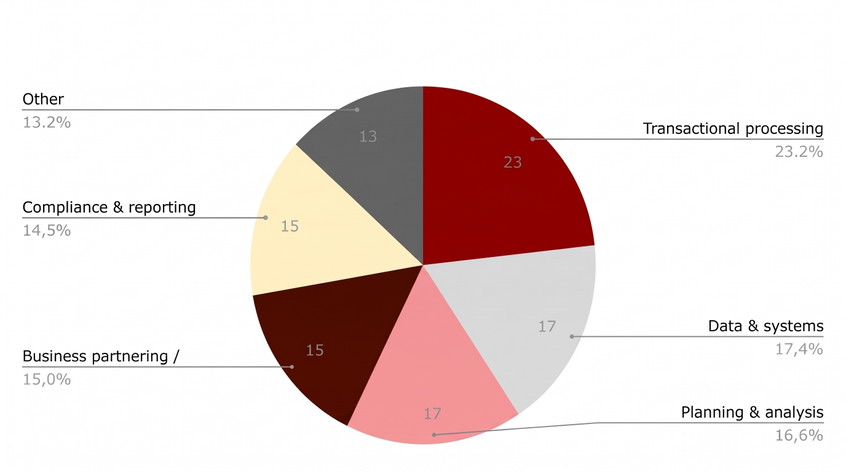
Today, nearly 40% of the total capacity within Finance is still devoted to transactional processing (23%) and compliance & reporting (15%). This stands in stark contrast to the 32% that remains for planning & analysis (17%) and business partnering/decision support (15%).
This is the familiar story of the capacity gap. The Finance team’s time is consumed by the past (reporting on what has happened) and by operations (processing transactions), leaving no room for future-oriented activities (forecasting, scenario planning, and strategic advising). Rather than a lack of willingness or expertise, this may be due to a faltering operating model in which data must be transformed manually and systems do not communicate seamlessly with one another.
4. Various approaches for every financial activity
When we zoom in on individual activities, it becomes clear that organizations in Belgium make very diverse choices. According to 49% of respondents, controlling is primarily handled locally, while 40% place this activity at the group level. For management reporting, the figures are 32% and 46%, respectively. Accounts Payable and Receivable are also not organized the same way everywhere: 35% say these activities are primarily handled locally, compared to 31% at the group level.
Regardless of the chosen model, the survey provides an indication of how much capacity is lost to activities that do not create direct value. Twenty-eight percent of respondents estimate that at least a quarter of total finance capacity is spent on this. Specifically, this includes, for example, data issues, duplicate entries, manual corrections, wait times, and inefficient processes. In 4% of organizations, this figure even rises to more than half of the time.
The discussion about the organization of Finance thus goes beyond the question of exactly where Finance activities are carried out. Whether centralized or decentralized is not an end in itself. It’s also about how efficient the chosen organizational structure is. Where are there unnecessary handoffs, duplicate tasks, data problems, or ambiguities in responsibilities? And how much capacity is consequently unavailable for planning, analysis, and business partnering?
Conclusion
The TriFinance Barometer 2026 does not show a clear trend toward either full centralization or decentralization. Organizations are opting for a variety of structures, but virtually all of them face the same problem: too much capacity remains tied up in transactional processing, basic reporting, and manual corrective work.
The future of Finance, therefore, is not about drawing up a new organizational chart, but about building an integrated operating model. This requires three concrete decisions: first, establishing end-to-end process ownership across departments; second, harmonizing the underlying master data and systems; and only then determining which tasks are best handled centrally or locally. Only in this way can Finance truly free up capacity for its role as a strategic co-pilot.


