
Financial reporting is under increasing pressure. In an increasingly data-driven environment, organizations are expected to deliver fast, accurate insights. Where reporting was once a periodic look back, executive committees today expect real-time insights, complemented by forecasting and impact simulations.
The traditional approach where management relied on disconnected spreadsheets, manual consolidations, and fragmented data sources has reached its limits. In a stable economy, descriptive, backward-looking reporting may have sufficed. That is no longer the case. Financial reporting has evolved from manual data capture to value-creating analysis and strategic insight.
In this blog post, we share key insights into how Belgian C-level executives view financial reporting. Our findings are based on a 2025 survey conducted by TriFinance among 120 C-level executives and senior managers.
The technology is already available. The real complexity lies in definitions, ownership, and trust in the numbers. Making data accessible is relatively straightforward. Making data truly usable requires robust governance.
Real-time access: myth or maturity test?
Inflation, supply chain disruptions, rapid market shifts, and geopolitical tensions are forcing organizations to make decisions based on up-to-date information. Strategic choices around investments, pricing, cost management, or talent planning cannot wait for a report that arrives weeks later.
Yet, the survey shows that real-time financial data is far from a given. Only 5% of respondents report that financial data is always immediately available. About one-third (34%) usually have direct access, but for the majority (55%), data is sometimes delayed or not available at all.
This is not merely an operational issue. Even within the C-suite, real-time insghts are not guaranteed. 38% of C-level executives have timely data only sporadically, while 17% experience significant delays.
Role-based differences are clear. 23% of CEOs report always having direct access to financial reporting. In contrast, 8 out of 10 Chief Data Officers (CDOs) and 6 out of 10 Chief Operating Officers (COOs) receive reports sometimes on time and sometimes too late. None in these roles report consistent real-time access.
This points to a lack of transparency and data consistency. Data may exist somewhere, but it is not necessarily uniform, integrated, or simultaneously accessible to all decision-makers.
Slowness as a Strategic Risk
“Real-time access is rarely purely a technical challenge,” says Maarten Lauwaert, TriFinance Expert Practice Leader, Data & Analytics. “The technology exists. The real complexity lies in definitions, ownership, and trust in the numbers. Making data accessible is relatively straightforward. Making data truly usable requires governance.”
The conclusion is clear: strategic decision-making is only as strong as the data it relies on. In many organizations, this data flow is delayed or incomplete. In a context where agility distinguishes leaders from followers, this becomes a structural risk. Real-time data is therefore not just a dashboard issue. It is a maturity test.
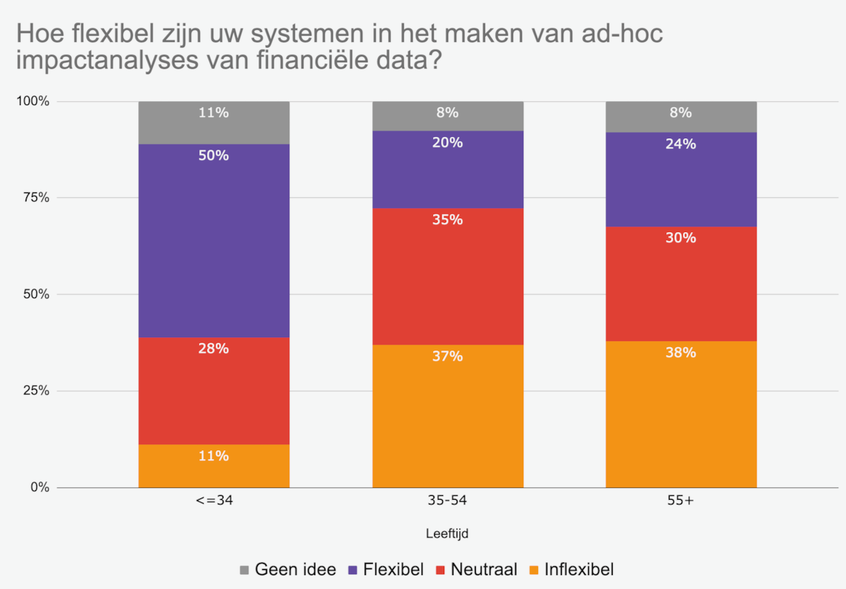
The flexibility categories are roll-ups of the following subcategories: Inflexible (very inflexible, manual and time-consuming + limited flexibility: some capabilities, but constrained); Neutral (basic analyses are possible, while more complex scenarios require significant effort); Flexible (most analyses can be performed quickly + highly flexible: real-time capabilities and advanced scenario modeling).
Bottlenecks in financial reporting
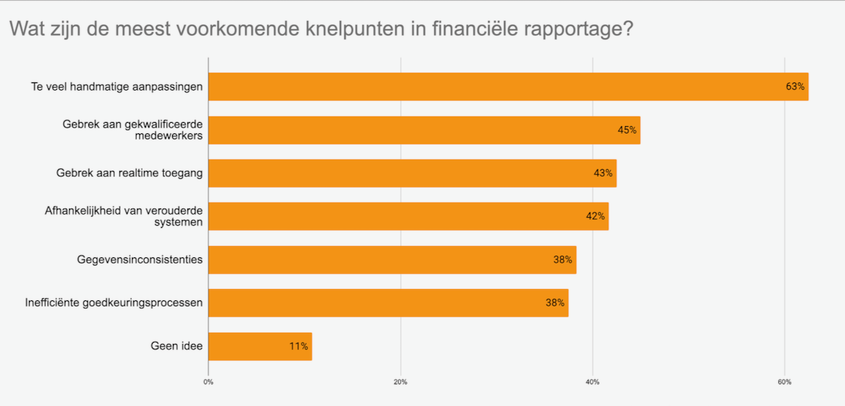
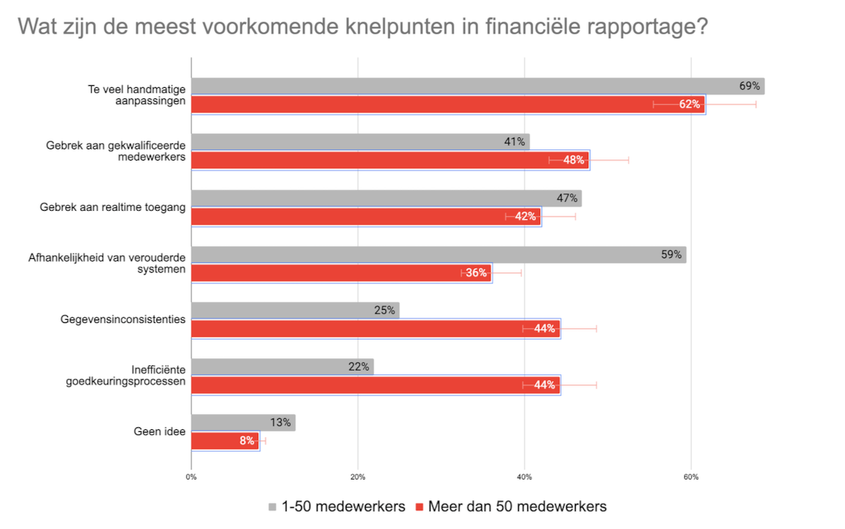
The survey shows clearly how the challenges in financial reporting go deeper than just real-time access. The most frequently cited bottleneck is excessive manual adjustments (63%). Smaller organizations are particularly affected, with 69% reporting a heavy reliance on manual interventions. This points to Excel-driven processes, correction cycles, and time-consuming reconciliations, raising both the risk of errors and delays.
“Reporting often relies on spreadsheets, manual consolidations, and limited automation,” says Maarten Lauwaert. “This is understandable: investments in integrated systems are often postponed as long as the complexity seems manageable.”
Additionally, 45% of Belgian organizations report a lack of qualified personnel. Notably, this concern is stronger among (senior) management (53%) than within the C-suite (37%). In lean teams, a few individuals often wear multiple hats, covering accounting, controlling, reporting, and sometimes even IT support. This high dependency on key personnel creates risks during growth episodes or staff turnover.
Real-time data is therefore not just a dashboard issue. It is a maturity test.
From umbers to scenarios: How flexible are our systems, really?
Real-time access is one thing—but what can you actually do with it when circumstances change?
When asked about the flexibility of systems for ad-hoc impact analyses of financial data, only 6% of respondents said their systems are highly flexible and capable of handling advanced scenarios. Another 20% reported that their environment is flexible enough for most analyses. This means that barely a quarter of organizations (26%) truly have agile analytical capabilities.
In contrast, 33% of organizations describe their systems as outright inflexible, time-consuming and limited in functionality. Another 33% fall in a neutral middle ground: basic analyses are possible, but more complex scenarios require significant effort. In other words, two-thirds of organizations cannot quickly and independently perform sophisticated impact analyses.
Generation gap or maturity gap?
Age-based differences are notable. Among respondents under 34, 50% consider their systems flexible. In the 35–54 age group, this drops to 20%, and among those 55+, to 24%. Conversely, perceptions of inflexibility are much higher in older groups (37–38%) compared with the youngest cohort (11%).
Several factors may explain this gap. Younger professionals may work more frequently in digitally mature environments or at least have higher expectations for technological agility. Alternatively, this could point to a maturity gap between organizations that have recently invested in integrated data architectures and those still relying heavily on legacy systems, although this latter factor only indirectly affects younger professionals’ experiences.
Legacy systems are not just a large-company problem
Beyond the heavy burden of manual adjustments, reliance on outdated systems stands out, especially in smaller organizations of up to 50 employees, where 59% cite this as a challenge, compared with 36% in companies with more than 50 employees. Legacy systems are clearly not just a large-company problem, on the contrary.
In smaller firms, system upgrades are often postponed due to budget constraints. Sometimes the organization grows faster than its IT architecture can keep up. What once sufficed becomes a bottleneck for reporting, resulting in more manual workarounds and limited real-time insights.
Larger organizations, by contrast, tend to struggle with complexity and integration challenges, while smaller companies are primarily vulnerable due to underinvestment and scale limitations. The strategic takeaway: a digital gap does not stem from company size but from delayed modernization.
In larger organizations, legacy system challenges also manifest as data inconsistencies (38%) and inefficient approval processes (38%), particularly within more complex organizational structures.
Two realities, one conclusion
Interestingly, the lack of real-time access is cited at roughly the same rate in both groups: 47% for smaller organizations and 42% for larger ones. However, the root causes differ fundamentally:
-
In smaller companies, delays stem from limited automation and capacity.
-
In larger organizations, delays arise from system complexity and governance challenges.
In other words: same symptom, different underlying dynamics.
New tools solve little without clear definitions, ownership, and processes. Without proper governance, reporting remains fragmented.
Challenges across technology, organization, and people
The results of the TriFinance survey make one thing abundantly clear: reporting challenges do not reside in a single domain, but across three interconnected levels.
1. Technology: Legacy and Integration
Many organizations struggle with outdated systems, fragmented ERP landscapes, and limited integration of data sources. This leads to manual corrections, reconciliations, and debates over which numbers are “correct.” Technology is often the visible bottleneck, but rarely the sole cause.
2. Organization: Governance and Processes
Equally critical are unclear definitions, fragmented data ownership, and inefficient approval workflows. When KPIs are interpreted differently or reports exist in multiple versions, delays and mistrust arise. Even the best technology remains underutilized without clear governance.
3. People: Skills and Capacity
Modern reporting requires more than accounting accuracy. Analytical skills, business insight, and data literacy are essential. Where capacity or expertise is lacking, the focus shifts to operational firefighting rather than delivering strategic insights.
As Maarten Lauwaert puts it: “New tools solve little if definitions, ownership, and processes are not clear. Without governance, reporting remains fragmented.”
The Bottom Line
Accelerating reporting is not simply a matter of adding dashboards. It requires an integrated approach where systems, processes, and responsibilities are aligned.
This raises the central question for every company: what role does Finance play in structuring data, maintaining definitions, and supporting decision-making?
In an economy where speed and accuracy make the difference, reporting is no longer a support function. It is a strategic capability. Organizations that recognize this build a single consistent version of the truth, creating the foundation for faster, better-informed decisions. Those that do not recognize this remain reporting on yesterday’s data while the market decides tomorrow.


