
The transformation of Finance is inseparable from the transformation of financial reporting and management reporting. While organizations increasingly position Finance as a strategic partner that enables data-driven decision making, reality tells a different story.
Across organizations, there is a growing gap between their reporting ambition and execution. Leaders invest in Business Intelligence and aim to increase analytics maturity. Still, many Finance teams experience the same operational bottlenecks. The result is a Finance function that has ambitions to look ahead, but in practice remains largely reactive. This disconnect is not new, and is explored in more detail in our article 'Why Business Intelligence quietly fails in Finance - and how to fix it'
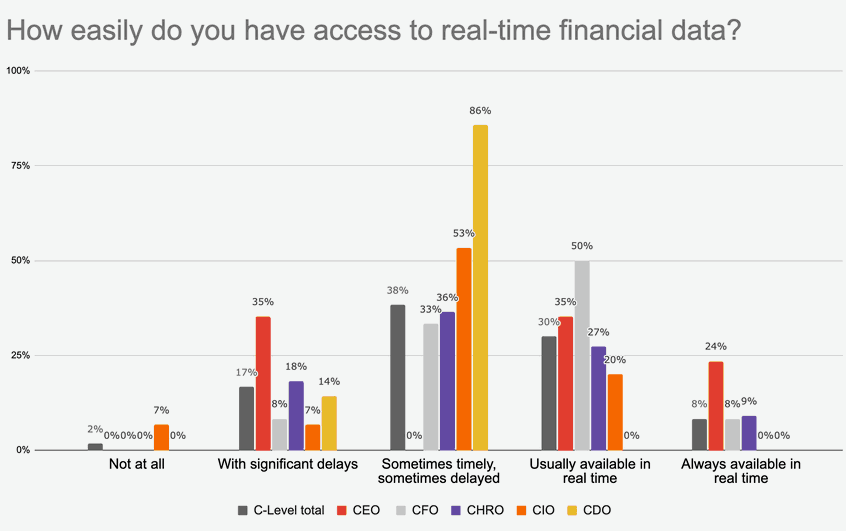
Why reporting holds back Finance transformation
Data from the TriFinance 2025 survey among C-levels and senior management confirms that Finance is often constrained by operational challenges. Slow financial reporting remains a bottleneck for 33% of respond.ents in Belgium. While regulatory complexity (45%), manual and time-consuming processes (42%), and a lack of system integration (41%) also rank high, reporting speed is really critical because it underpins an organization’s ability to data-driven decision-making.
Slow reporting is rarely an isolated issue, it is the visible symptom of deeper structural problems. Fragmented systems, poor data quality (34%), and labor-intensive processes all contribute to delays in management reporting.
Interestingly, perspectives differ across leadership roles. CFOs tend to frame slow reporting as part of broader operational inefficiency, while CIOs link it to technology and data constraints. This misalignment highlights a key challenge: improving reporting speed is not just about accelerating reporting output, but about reinforcing the underlying foundations required for true finance transformation.
Slow reporting is rarely an isolated issue, it is the visible symptom of deeper structural problems. Fragmented systems, poor data quality (34%), and labor-intensive processes all contribute to delays in management reporting
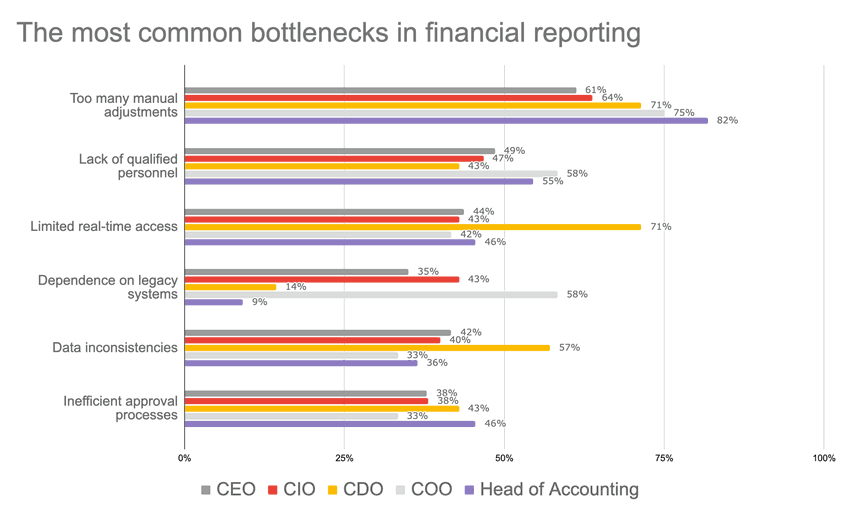
The bottlenecks in financial reporting
A closer look at the data reveals that reporting challenges go beyond speed alone. The most frequently cited issue is the reliance on manual adjustments (63%), confirming that many organizations still depend heavily on spreadsheets and manual workflows in their financial reporting processes. This challenge is even more pronounced at the operational level, where up to 82% of Heads of Accounting and 75% of COOs report excessive manual interventions, compared to 61% of CEOs.
At the same time, structural challenges put serious limitations on data-driven decision making. A lack of real-time access (43%) and data inconsistencies (38%) point to fragmented data landscapes and the lack of a single source of truth. These issues are specifically flagged by CDOs, of which 71% report limited real-time access and 57% struggle with inconsistent data, clear indicators of low analytics maturity. By contrast, other roles report significantly lower levels of data constraints, suggesting that the perception of data maturity varies widely across leadership functions.
Organizational constraints further complicate the picture. Nearly half of respondents (45%) report a shortage of qualified staff, with CHROs (64%) emphasizing this most acutely. The talent gap is also visible across operational roles, with 58% of COOs and 55% of Heads of Accounting highlighting capacity constraints. Meanwhile, CFOs highlight inefficiencies in approval processes (58%), and CEOs express strong concern about legacy systems (82%).
Taken together, these findings highlight a structural pattern: without addressing manual processes, data fragmentation, and capability gaps, efforts to modernize management reporting and advance analytics maturity will remain limited in impact.
Without addressing manual processes, data fragmentation, and capability gaps, efforts to modernize management reporting and advance analytics maturity will remain limited in impact
Priorities of the C-Suite
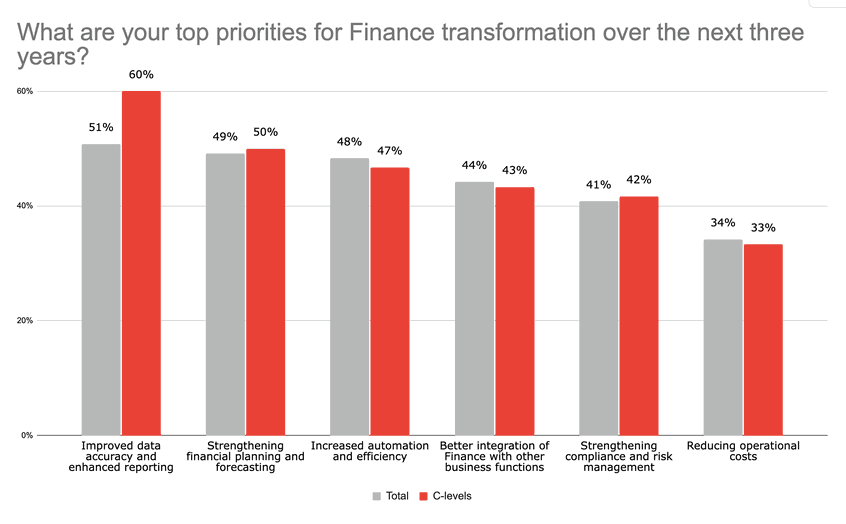
Looking ahead, the priorities set by executives clearly reflect these challenges, reinforcing the urgency of Finance transformation.
Improving data accuracy and strengthening financial reporting emerges as the top priority (50% overall, rising to 60% among C-levels). This emphasizes the importance of reliable data as the foundation for effective data driven decision making.
Closely following is the strengthening of financial planning and forecasting (49%), signaling a clear ambition to move beyond backward-looking management reporting toward more predictive, forward-looking insights.
Finally, increased automation and efficiency (48%) remains a key focus. This confirms that reducing manual processes is not just about cost savings, but about enabling scalability and freeing up capacity for higher-value activities.
Together, these priorities point in a clear direction: organizations are actively trying to evolve toward more mature, insight-driven Finance functions, supported by Business Intelligence and higher levels of analytics maturity.
From reporting bottlenecks to strategic impact
The path forward is clear, but not simple. Finance transformation cannot succeed without fundamentally rethinking financial reporting and management reporting.
As long as reporting remains slow, fragmented, and backward-looking, Finance will struggle to fully deliver on its strategic ambitions. But by strengthening data foundations, embracing Business Intelligence, and accelerating analytics maturity, organizations can shift from reactive reporting to proactive data driven decision making.
Only then can Finance truly evolve from scorekeeper to strategic partner.


