
In many organizations, the executive dashboard is the Business Intelligence tool that receives the largest investment, yet is used the least. That may sound harsh, but it is exactly what we see in practice. Dashboards filled with visuals, tabs, and KPI lists are built with the best intentions, but executives often open them only once, after which they are quietly abandoned.
Executive decisions are still being made based on familiar Excel reports and board presentations. Or decision‑makers simply ask their controllers “what the numbers really say.”
Below, we bundle our experience in Business Intelligence, management reporting, and performance management into a number of concrete guidelines that help build executive dashboards that actually work.
Why so many executive dashboards fail: built from data and tooling instead of decisions
An executive dashboard is often built around available data or around the capabilities of financial reporting software and BI tools. What is missing is the defining question that should guide the entire design: Which executive decisions does this dashboard need to support?
When this step is skipped, three classic issues emerge that undermine adoption:
1. Irrelevance
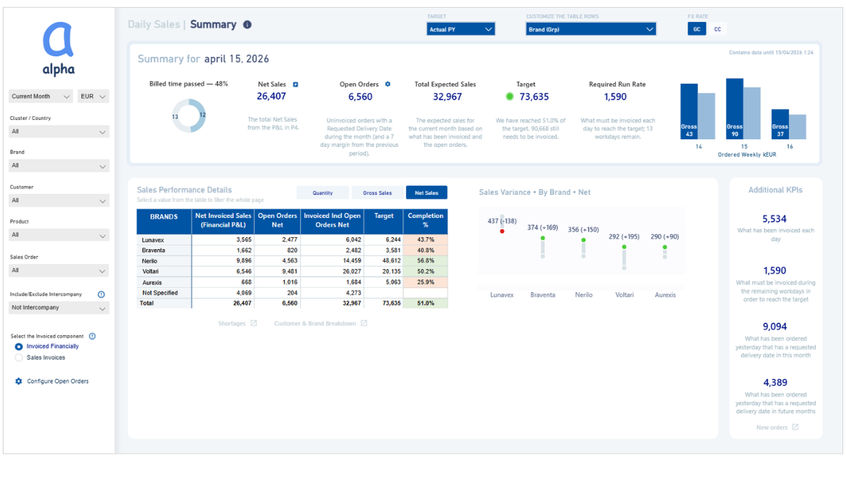
Executives are presented with metrics, but no management insights. A revenue figure of 4.2 million means nothing without a target, a trend, and an explanation.
Without interpretation, a management dashboard becomes a source of follow‑up questions rather than a decision‑enabling tool.
2. Cognitive overload
Executives do not want to combine ten filters, five tabs, or four different charts to reach an insight. A strong executive dashboard guides their attention.
If interpretation requires effort, adoption drops sharply.
3. Loss of trust
Nothing erodes confidence faster than inconsistent data. This is not only about data quality, but also about definitions.
When revenue or margin means something different in finance than it does in sales, conversations shift from decisions to debates about numbers. A single unreliable figure is enough to put the entire dashboard in doubt.
The conclusion is consistent: an executive dashboard that does not start from real decision moments will not be used.
Building from decision needs, not from available data
The starting point of every effective executive dashboard is straightforward: Which decisions does this executive need to make on a recurring basis, and what information is required to do so with confidence?
At TriFinance, we approach this in three steps:
1. Stakeholder conversations
We engage with controllers, business stakeholders, and of course executive leadership itself. Workshops can be useful, but the key is focus.
Questions such as “What keeps you up at night?” or “What information do you need before stepping into a board meeting?” reveal far more than “What would you like to see on the dashboard?”
2. Analysis of existing reporting
Existing financial reporting tools, Excel‑based reporting, and board decks already reflect part of the information landscape. Even more revealing are the ad‑hoc questions that controllers regularly receive. These requests expose where insight is missing and which topics truly matter at executive level.
3. Translating into KPIs, insights, and visualizations
Defining relevant KPIs is not an end result. It is a starting point that must be enriched with targets, trends, and value drivers to become executive‑ready.
Starting from the decision rather than from the data remains the most underestimated success factor in performance reporting. This analysis forms the content blueprint for an executive dashboard that not only looks polished, but is actively used.

Executive insights: the step most dashboards overlook
Executives do not steer based on tables. They steer based on meaning.
That is why simply displaying KPIs is not enough. An executive dashboard must make the story behind the numbers clear and actionable.
This requires three distinct layers:
- Context: Targets, benchmarks, and trends make a KPI interpretable. A number without reference is noise.
- Drivers: Why is this happening? Which regions, product lines, or customer segments are driving the variance?
- Impact: Not every movement warrants attention. A decline in a small segment requires a different response than a modest decline within a core business area.
An insight such as “Revenue is 8 percent below target due to three underperforming regions” contributes more to performance management than six charts combined. It removes ambiguity, accelerates decision‑making, and immediately focuses the discussion.
An executive dashboard can be technically flawless, but without clarity on the decisions it is meant to support, it becomes little more than a well‑designed infographic.
Without data governance, there is no usable executive dashboard
An management dashboard can only be trusted if the underlying data architecture is equally trustworthy. Data governance is not an IT exercise; it is a prerequisite for any form of BI or executive performance reporting. Three elements are essential:
1. Clear and consistent definitions as a foundation of trust
If revenue, margin, or headcount is interpreted differently across departments, no executive dashboard can be relied on. A centralized data catalog within the BI environment, or tools such as dScribe, create clarity and consistency.
2. Transparent and stable data sources
Executives do not need to understand the technical construction of data pipelines, but they must have confidence that all figures originate from a single, consistent source. This requires a logical, cleaned, and well‑managed data architecture. Without it, parallel datasets emerge, manual reporting increases, and multiple versions of the truth take hold.
3. Realistic refresh cycles aligned with executive decision cadence
Live reporting may sound appealing, but without a robust data model it mainly introduces noise. For leadership teams, daily micro‑fluctuations often cause confusion rather than insight. Governance here means determining a refresh frequency that is realistic, feasible, and relevant within the existing architecture.
Strong data governance is therefore not optional. Without a solid foundation, an executive dashboard is nothing more than a polished visualization built on unstable ground.
Without shared definitions and transparent data sources, you are not building an executive dashboard, you are building a discussion platform
Design: clarity over flexibility
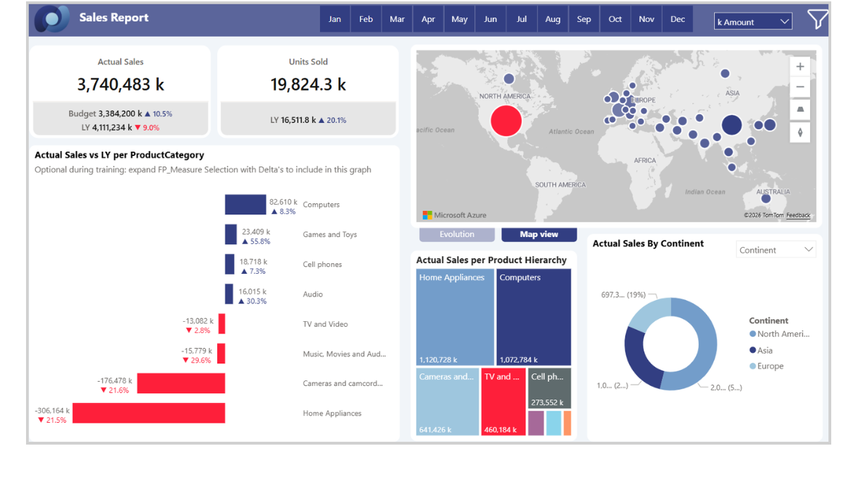
Even an executive dashboard with perfect data can fail due to poor design. Executives prioritize speed and scannability. Long texts, side‑by‑side table comparisons, or drilling through reports across multiple levels work against that goal.
Executive dashboards only work when:
- the most critical KPIs are immediately visible at the top
- color and placement guide attention
- unnecessary noise is removed
- users never have to search for key information
- drill‑down is optional, not mandatory
An executive dashboard does not need to offer the full functionality of self‑service BI. Self‑service BI is valuable for business users who want to explore data in depth. For executives, the opposite is true. Excessive flexibility increases cognitive load and raises the risk of misinterpretation.
That is why we opt for controlled self‑service: limited filters, field parameters showing only relevant perspectives, and bookmarks for frequently used views. This delivers flexibility without sacrificing focus.
Functional choices that make the difference
An executive dashboard becomes valuable only when its functionality aligns with how leadership teams actually use it. In practice, the following elements consistently add value:
- Clear signal thresholds: deviations from targets are immediately visible
- Limited drill‑down: one level deeper, not five
- A stable management reporting format without unexpected changes
- Export options for board‑level reporting
- Consistent design across all pages
Equally important: an executive dashboard should never feel like a puzzle. It should function as a simple digital decision‑support tool, not as a complex BI system.
Dashboards that evolve together with their users do not become BI deliverables, but an integral part of how organizations are led
Building an executive dashboard: why an iterative approach delivers better results
The biggest mistake organizations make when developing executive dashboards is trying to deliver everything in a single release.
An executive dashboard only reaches maturity after feedback from the leaders who rely on it. That is why we work iteratively: present an initial version, gather feedback, refine, present again, and fine‑tune.
This approach:
- improves content relevance
- shortens time to value
- increases executive adoption
Across our projects, the pattern is consistent: organizations that work iteratively use their executive dashboards. Organizations that take a big‑bang approach do not.
A strong executive dashboard changes how decisions are made
When an executive dashboard functions as intended, conversations shift. Meetings no longer focus on validating numbers, but on deciding what to do next.
Leadership teams align around a shared view of performance, discussions become more strategic, and decision quality improves.
The real value lies not in the visualizations themselves, but in the clarity and speed they enable.
Unlock more value from your data with combined BI and finance expertise
An executive dashboard only truly delivers value when technical BI capabilities and financial logic are perfectly aligned. This is where TriFinance makes the difference. We combine deep experience in Business Intelligence with strong expertise in finance and controlling. The result: executive dashboards that are not only well designed, but also substantively sound and strategically actionable.


