
Effective business steering requires sharp, data-backed decisions amidst growing operational complexity. Yet management reporting often fails, not from a lack of reports, but due to misaligned fundamentals like poor data quality, inconsistent definitions, and weak ownership.
These are rarely "tool problems". Instead, these misaligned fundamentals force teams to waste time debating data rather than making decisions.
In a recent TriFinance webinar, Maarten Lauwaert (Expert Practice Leader Data & Reporting) and Sophie Van Lier (Senior Manager Data & Reporting) mapped a pragmatic route to a scalable to-be reporting stack. They emphasized that while technology and AI are powerful enablers, they strictly require a governed, solid data foundation to succeed.
Defining true management reporting
Organizations often blur the lines between statutory, corporate, operational, and management reporting.
Statutory and corporate reporting are strictly designed for compliance and external stakeholders like banks and regulators, adhering to fixed frameworks like IFRS or CSRD. Because its frequency is low and its standard structure does not map to internal operations, it falls short as a tool for steering the business.
On the flip side, operational reporting drives day-to-day departmental activities through highly specific, fluid KPIs. While it serves as a critical foundation for explaining numbers, its micro-level detail easily overwhelms senior leadership.
True management reporting bridges this gap by focusing on financial and non-financial data specifically curated to introduce accountability, transparency, and data-driven insights for the executive team and the board. Instead of merely looking backward, a well-designed setup combines periodic historical performance with forward-looking budgets, forecasts, and scenario models. This empowers leaders to look beyond the static numbers and answer pivotal, actionable questions: Why are we over- or underperforming? What can management actively influence? And what concrete decisions should we take right now?
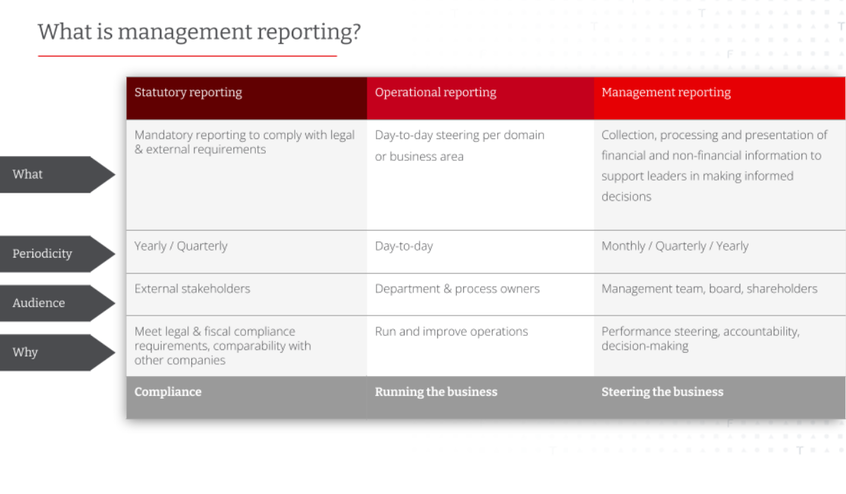
Ideally, operational, managerial, and statutory reporting are built on the same underlying data. A single, consistent data foundation allows figures to be seamlessly compared across layers, making it much easier to explain variances.
The building blocks of a strategic management reporting pack
The foundation of effective management reporting must rest entirely on an organization's core strategy and direction. To translate high-level business ambitions into measurable performance, companies need a balanced mix of lagging indicators (such as actual margins) to review past results, and leading indicators (such as sales pipeline data) to anticipate future performance. This forward-looking perspective should also distinguish between secured and unsecured revenue to assess exactly how much of a forecast is exposed to operational uncertainty.
The five key components of a solid management reporting format
Transforming traditional ledger data into an actionable, management-ready package relies on structuring the figures around five core reporting formats:
- Functional P&L: Moving beyond a statutory "P&L by nature", this view structures costs by internal function and responsibility, utilizing standard costing to expose actionable performance variances.
- Restructured balance sheet: Rather than standard asset and liability listings, this framework answers where capital is deployed and how it is financed, tracking net debt closely for covenant compliance and valuation context.
- Dual cash flow forecasting: Integrating a long-term indirect method for simulating financing needs with a short-term direct method based on active pipeline, payroll, and purchase data.
- Multi-dimensional KPIs: Combining financial metrics with operational, commercial, and process KPIs (like lead times or utilization rates) that serve as early warning signals before changes impact the P&L.
- Narrative layers: Pairing raw metrics with qualitative explanations of underlying trends, risks, and specific corrective actions.
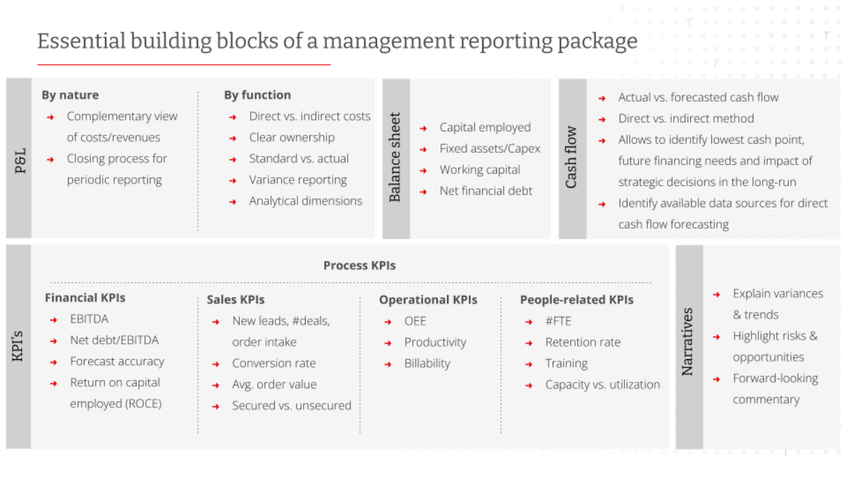
Reporting in many organizations has become a repetitive habit rather than a strategic tool used to steer the business. To drive true accountability, your reporting pack must move beyond pure accounting structures to establish clear functional ownership.
Navigating common reporting pitfalls
Even with the best intentions, reporting initiatives frequently stumble over a series of predictable, structural obstacles. To build a resilient reporting stack, finance teams must actively recognize these pitfalls and implement clear strategies to overcome them.
- Disconnection from strategy: Regularly step back to review the business strategy and ensure the reporting framework is actively measuring the right things.
- Information overload: Apply a "less is more" philosophy by building high-level overviews that allow users to drill down into deeper details only when needed.
- Poor data quality: Establish clear ownership over data entry points and embed automated validation check reports directly within your analytics tools.
- Inefficient processes: Simplify and standardize your core closing and reporting cycles first, then leverage technology to automate the repetitive parts.
- Lack of KPI ownership: Explicitly define who is accountable for specific KPIs and key operational lines, such as OPEX or production variances.
- Inconsistent data definitions: Drive cross-departmental alignment on exact metric calculations and make these definitions visually accessible within the reports.
- Over-engineered cost allocations: Maintain absolute transparency by always separating original department costs from any allocated corporate overhead.
- The technology trap: Resolve underlying process flaws before implementing new tools, ensuring technology serves to simplify reporting rather than accelerate chaos.
Transitioning from as-is to to-be reporting
Shifting from a fragmented reporting setup to a modern, scalable architecture is a structured journey rather than a one-off technology installation. Successful organizations execute this evolution by looking through four distinct lenses:
Strategy: Aligning the core purpose of management reporting with the specific steering decisions leadership must make. Read more on building executive dashboards that drive decisions
Data and technology: Mapping out current data flows, identifying where manual reporting and ad-hoc interventions occur, and designing a future-proof data pipeline with built-in validation controls.
People: Involving finance, IT, and business stakeholders early to establish unambiguous ownership over data lines and training internal champions to encourage independent adoption.
Processes: Establishing a governed, repeatable closing calendar and optimizing end-to-end reporting steps so the team can pivot away from data collection toward strategic analysis.
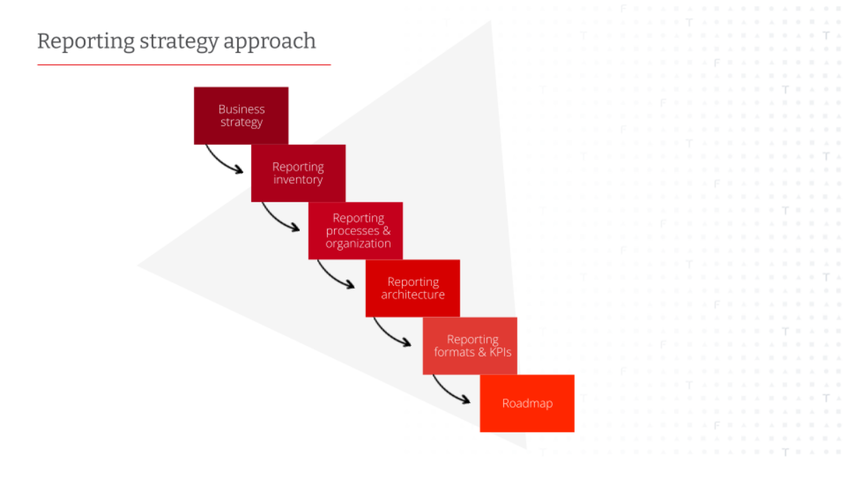
This transformation begins by taking an honest inventory of existing reports and their underlying logic. From there, organizations define a clear target architecture, agreeing on exactly which reports belong in which systems, before building out a prioritized roadmap to implement changes incrementally.
Designing a modern technology stack
Once the functional foundations are clear, technology becomes a critical enabler for automation, speed, and establishing a clear data & analytics foundation as single source of truth. A mature, modern reporting architecture operates in distinct layers to ensure scalability:
1. The data platform layer
At the center sits a consolidated data platform such as Microsoft Fabric or Databricks which ingests and structures information from fragmented source systems like ERP, HR, and sales software. By cleansing and organizing data in a central hub, businesses can feed operational, managerial, and statutory reporting from one unified data foundation, making variance analysis seamless.
2. The analytics layer
For visualization and end-user exploration, Business Intelligence platforms like Power BI excel at storytelling and drill-down functionality. Setting up management reports within this layer allows users to view high-level strategic KPIs and instantly deep-dive into the underlying operational data within a single user interface.
3. The Enterprise Performance Management (EPM) layer
Dedicated Enterprise Performance Management or EPM systems support specialized finance workflows and generally divide into two core capabilities:
FP&A solutions: Dedicated platforms (such as Vena Solutions or Aimplan) that manage data input, auditability, and scenario modeling for budgeting and forecasting.
Consolidation solutions: Corporate software (such as Lucanet) designed to streamline complex external compliance requirements, including intercompany eliminations, foreign exchange revaluations, and statutory disclosures.
In a best-practice setup, data from these EPM solutions is pushed right back into the central data layer, enabling teams to easily compare real-time actuals against budgets directly inside their Power BI dashboards.
Before you can unlock the power of AI, you absolutely must have a governed central data layer with clear definitions, security, and ownership in place. Without that structural context, AI outputs quickly become dangerous and unreliable.
The emerging role of AI in the reporting cycle
With a clean, governed data layer established, artificial intelligence can introduce substantial efficiencies across four main areas of the finance department:
Closing automation: Utilizing AI engines embedded in modern EPM tools to actively scan for accounting anomalies and automate complex data reconciliations.
Drafting commentary: Leveraging large language models to quickly generate initial analytical drafts explaining performance drivers and variance trends.
Advanced forecasting: Incorporating accessible predictive algorithms to refine scenario planning and uncover underlying business patterns.
Conversational data access: Implementing virtual co-pilots that enable business leaders to query reports and generate custom views using natural language.
Ultimately, while these technologies speed up the collection and synthesis of information, finance and management always remain fully accountable for interpreting the insights and executing the decisions.
Looking ahead: continuous refinement
Building a mature management reporting stack is not a one-time IT implementation, but a continuous journey of organizational refinement. By aligning your financial and operational data with your core business strategy, establishing unambiguous ownership, and structuring repeatable processes, you transform the finance department from a reporting factory into a strategic advisor. While modern Business Intelligence platforms, specialized EPM software, and emerging AI tools provide incredible leverage, their ultimate success depends entirely on the health of your reporting foundation.
Navigating this transition requires a careful assessment of your unique organizational architecture. If you are ready to evaluate your current as-is setup and build a scalable, future-proof reporting framework tailored to your business reality, the TriFinance team is here to help you map out a clear path forward.


