
Finance teams today face a clear mandate: plan faster, forecast more frequently, and deliver better strategic insights. Yet, the reality remains that many planning and budgeting processes still depend on fragmented Excel files, manual consolidation, and persistent version-control issues.
In our recent Demo Friday webinar, we partnered with Vena Solutions to explore how this FP&A platform helps you to streamline your planning, budgeting and forecasting. Together with Aliya Alladina (Senior Solutions Consultant at Vena Solutions), we demonstrated how shifting to a dedicated system brings the governance and automation needed for strategic, connected planning.
The tipping point: When to move beyond Excel
A crucial question to begin with: When is the exact right moment to move from Excel to a dedicated FP&A platform?
Excel itself is not the problem; it remains an incredibly powerful and familiar tool. However, the tipping point is reached when finance teams spend more time collecting inputs, verifying versions, and correcting errors than analyzing data.
This operational friction usually accelerates during specific organizational shifts:
- Moving from a yearly budget cycle to monthly or quarterly forecasting.
- Scaling rapidly with an increasing number of legal entities, departments, and decentralized budget owners.
- Navigating organizational growth driven by mergers and acquisitions.
In these scenarios, manual spreadsheet management becomes a severe bottleneck. Finance teams require a more controlled environment that provides structural integrity, governance and faster consolidation.
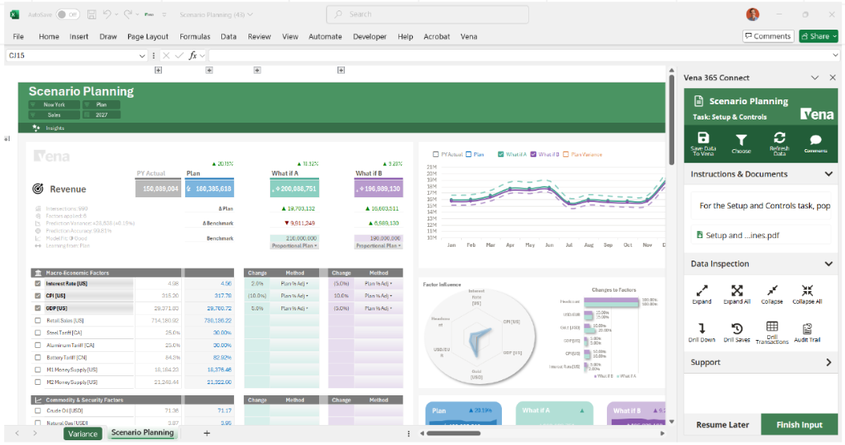
What sets Vena apart: an Excel-based front end integrated in a robust FP&A platform
To address these challenges for clients seeking to retain their spreadsheet workflows, TriFinance leverages Vena Solutions as a key component of its technology toolbox.
Vena’s core differentiator is that its front-end runs natively in desktop Excel. Budget holders input data into templates they already understand, minimizing user friction and drastically driving up internal adoption rates.
Simultaneously, Vena wraps this familiar interface in a robust, multi-dimensional enterprise cloud layer to ensure absolute data quality and governance:
- Built-in workflow control: Visual workflows automate tasks and approval hierarchies, while a live dashboard lets administrators monitor organization-wide budgeting status in real-time.
- Traceability and auditability: Every data save is centralized in the cloud, capturing a detailed, color-coded audit trail of who modified what and when.
- Advanced ecosystem integration: As a premier Microsoft partner, Vena integrates seamlessly with the Microsoft stack, including Power BI (for pre-built dashboards via Vena Insights), Microsoft Teams, and Microsoft Fabric.
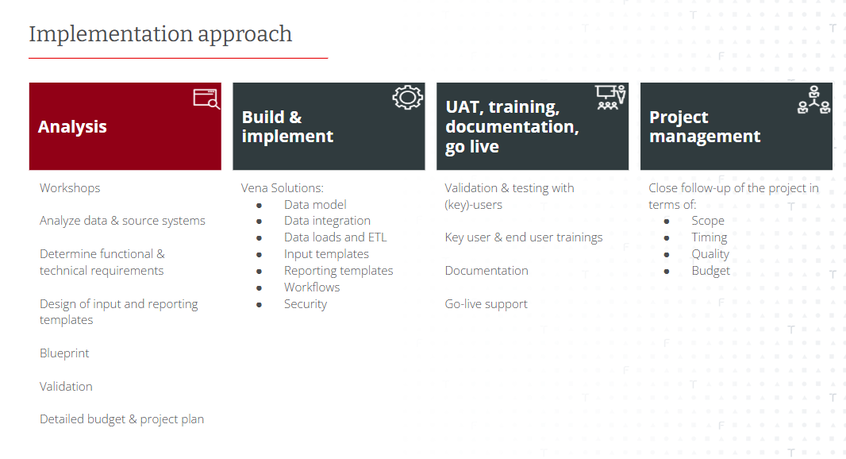
Vena provides the software platform, while TriFinance acts as the implementation and business partner. We translate complex finance processes into a practical system layout: conducting workshops, designing templates, and architecting the data model to ensure it delivers real steering value.
Breaking down silos with connected planning
A mature FP&A platform should not operate as an isolated software silo for the finance team alone. The ultimate value lies in a unified platform approach or connected planning.
Take workforce planning: if you structure personnel metrics consistently (tracking FTEs and salary components), that data is collected just once. It can then automatically drive the operational budget, simulate downstream cash flow impacts, and supply necessary data for ESG reporting without duplication of effort.
Enterprise AI: boosting efficiency within a secure framework
This clean, governed data layer is also the fundamental prerequisite for successfully adopting Artificial Intelligence in finance. AI tools require absolute structural context to deliver reliable outputs, meaning AI will not replace platforms like Vena; rather, the real power lies in combining both.
Vena embeds AI capabilities directly via Vena Copilot, a specialized FP&A agent. During the live demonstration, Aliya Alladina showcased how users can execute complex tasks using simple natural language prompts. For example: prompting the system to “take prior year actuals and increase by 10%”. The copilot automatically scans the multidimensional data model, calculates the logic, and populates the spreadsheet cells safely while inheriting all existing user-level security permissions. For maximum flexibility, Vena also allows you to securely connect your preferred external AI assistants, such as Claude and ChatGPT, to your structured data model.
Navigating implementation pitfalls
Deploying a new FP&A platform requires more than just a software license. To secure a rapid return on investment, we advise to use our proven implementation methodology to avoid common implementation pitfalls:
- Treating the tool as a standalone system: Without a clear data strategy and reporting architecture, you risk transferring poor data quality into a new system. Best practice dictates defining source integrations and reporting connections upfront.
- Lacking clear internal direction: When different business units operate differently, these discrepancies must be resolved before technical workshops begin. Internal alignment on scope and methodology is critical.
- Overloading the initial scope: Attempting to build every use case at once dilutes focus. A better approach is to start small with core budgeting, while designing the model to accommodate future extensions.
- Stopping at go-live: A successful digital transformation requires user adoption. Organizations must establish a clear ownership plan, providing the necessary training and support to embed the new way of working.
Ready to elevate your financial planning?
Moving from a fragmented planning, budgeting and forecasting landscape to a modern FP&A platform allows your finance team to shift focus to strategic decision-making. If you are ready to evaluate your current setup and explore how a platform like Vena Solutions can streamline your forecasting and budgeting processes, the TriFinance team is here to guide you.


