
In a previous blog post, "How Belgian C-Suite executives view financial reporting”, we discussed how senior leaders see financial reporting, zooming in on the key challenges of speed, accuracy and relevance. In this article, we go one step further by examining a critical underlying driver: analytics maturity, and how it shapes the effectiveness of Finance, enabling data-driven decision making.
What is data & reporting maturity?
Data and reporting maturity is more than tools and dashboards. It reflects how well an organization can transform data into actionable insights and support data-driven decision making. Maturity is defined by four dimensions:
- Data foundations: availability, integration and quality of data
- Reporting capabilities: ability to deliver accurate and timely insights in management reporting
- Analytics maturity: progression from descriptive to prescriptive analytics
- People and skills: expertise and culture to interpret and act on data
Maturity is clearly not a static state, but a journey from backward-looking financial reporting to forward-looking data-driven decision-making.
The analytics maturity gap that limits the impact of reporting
Insights from a TriFinance survey among C-level and senior management indicate that most organizations still operate at relatively low levels of analytics maturity. Nearly half of Belgian C-level executives (45%) indicate their organization is at a diagnostic level (understanding why things happened). In contrast, only 18% and 14% report predictive and prescriptive capabilities respectively, meaning that they can either predict what is likely to happen or use data, algorithms, and sometimes AI these days to recommend actions that will lead to a desired outcome.
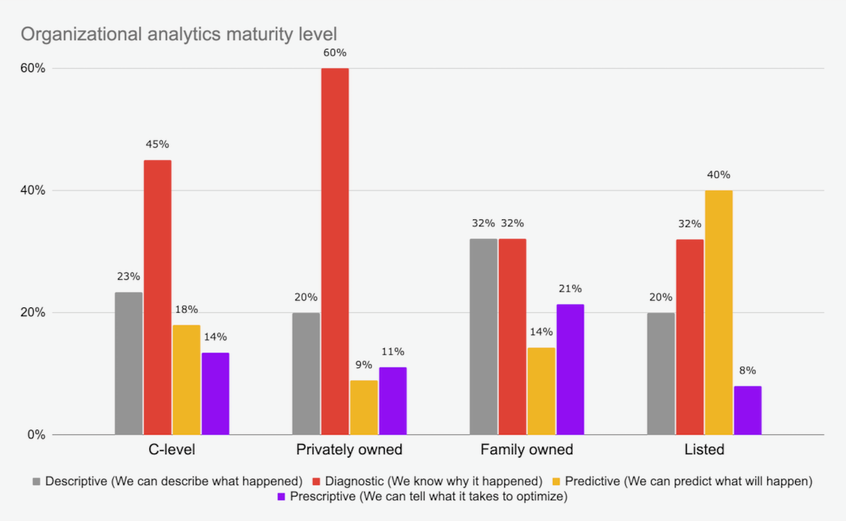
This imbalance is significant. While many Finance teams have moved beyond basic descriptive management reporting, only a minority is leveraging business intelligence and advanced analytics to anticipate what’s coming and support better decisions. As a result, the Finance department is more reactive rather than forward-looking.
Maturity also varies across organizations. Larger organizations and listed companies tend to show higher levels of predictive analytics. Similarly, organizations undergoing transformation (54% of respondents) are more likely to progress toward advanced analytics. This highlights that maturity is not just a technological issue, but closely linked to organizational ambition and change capacity.
The evolving but constrained role of Finance
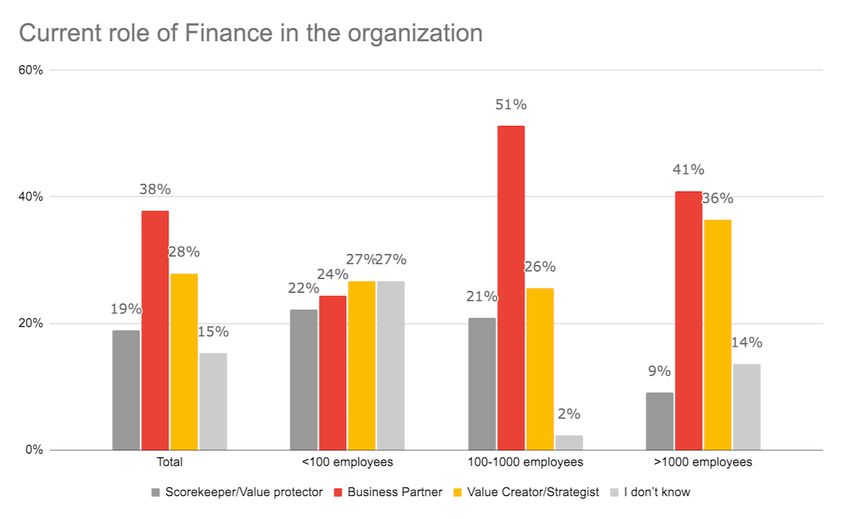
If we look at the role of Finance in organizations located in Belgium, it is slowly evolving. Most organizations position it as a business partner (38%) or value creator (28%), signaling a shift toward more strategic involvement.
But a significant part of respondents still see the department’s role as that of a traditional scorekeeper (19%), and 15% of respondents are even unclear about its role, demonstrating uncertainty about the functions place in the organization. This is particularly the case in mid-sized organizations where uncertainty rises to 27%. Larger organizations show more maturity and clarity, with 51% defining finance as a business partner.
A slow evolution in reporting capabilities
This perception stands in stark contrast to the perceived maturity levels of reporting capabilities. With the majority of organizations still operating at descriptive (23%) or diagnostic (45%) levels, financial reporting remains largely backward-looking. It is mostly focused on explaining past performance instead of shaping future results.
Only a limited share reaching predictive (18%) or prescriptive (14%) analytics. This indicates that financial reporting remains largely backward-looking and focused on explaining past performance rather than enabling forward-looking data-driven decision-making. As a result, there is a clear mismatch between the strategic expectations placed on Finance and the insights it can actually deliver.
Until reporting evolves toward more predictive and prescriptive capabilities, Finance teams will remain constrained in fully realizing their role as strategic partners and value creators.
Conclusion: Finance transformation requires reporting transformation
The transformation of Finance is therefore inseparable from the transformation of reporting. Moving beyond retrospective financial reporting toward forward-looking insights is simply a prerequisite for successful Finance transformation.
Only by strengthening data foundations and advancing analytics maturity supported by business intelligence can organizations enable Finance to truly evolve from scorekeeper to strategic partner.


